
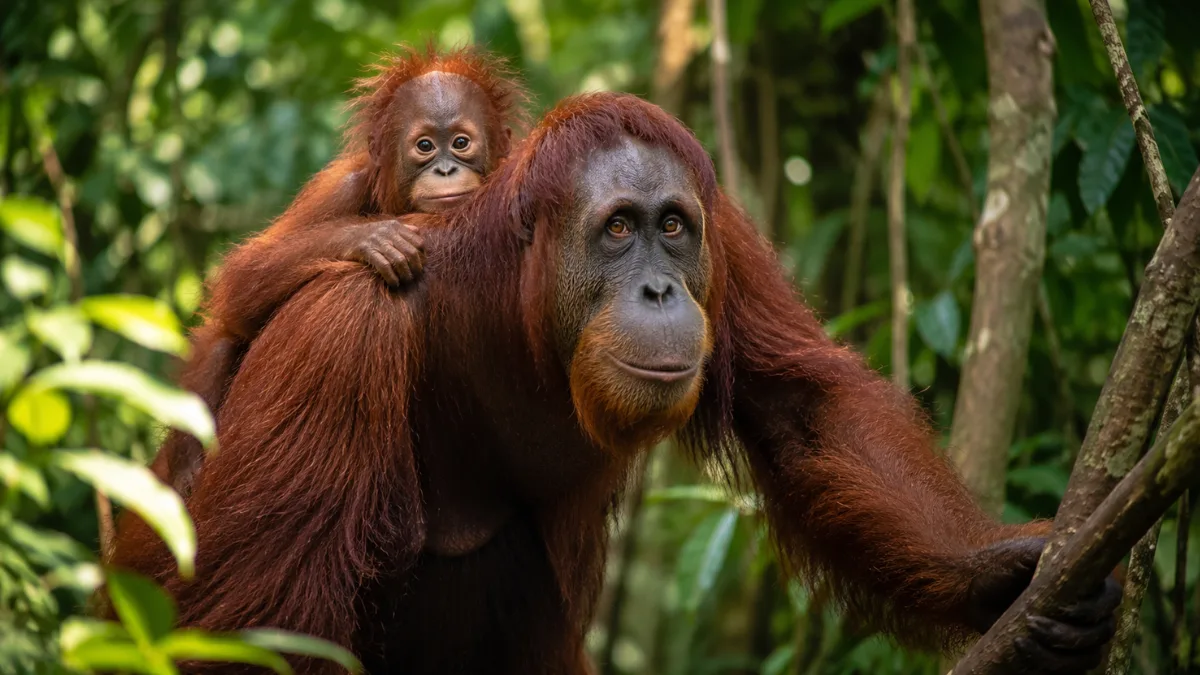

Why do orangutan mothers travel farther when their young play? A long-term study found that wild Bornean orangutan mothers with similarly aged offspring used shared forest areas more intensely, travelled farther around play encounters and spent less time feeding on play days.
These patterns suggest that mothers may actively increase their young animals’ chances of meeting suitable play partners. However, the study did not prove that orangutans plan meetings in the same way human parents arrange playdates.
The findings come from a June 2026 preprint that had not completed peer review when released. The results provide important early evidence, but scientists may refine the conclusions after further review and research.
Researchers use the word “playdate” as a convenient description. It does not mean that orangutan mothers agree on a fixed time or location. Instead, the mothers appear to adjust how they use familiar forest areas when a compatible young orangutan lives nearby.
That behaviour is surprising because orangutans have a semi-solitary social system. Young orangutans do not grow up inside permanent troops filled with similarly aged companions.
Their opportunities to meet another youngster depend heavily on where their mothers choose to travel.
Why Is Peer Play Hard for Young Orangutans to Find?
Adult female orangutans usually travel with their dependent offspring rather than living in a stable social group.
A mother generally raises one youngster at a time. The offspring remains dependent on her for years while learning how to move through the forest, locate food, handle difficult plants, build nests and recognise danger.
This creates an unusually close relationship between mother and young. However, it gives the youngster fewer regular opportunities to interact with peers.
Young members of more social primate species may have siblings and several similarly aged companions nearby. They can chase, wrestle and practise social behaviour without travelling far from their group.
A young orangutan faces a different situation.
The nearest potential playmate may live with another mother whose range overlaps only partly with its own family’s range. Even when two mothers live near each other, their youngsters may not be close enough in age to play comfortably together.
Age matters because an infant and an older juvenile have different strength, mobility and independence. Young orangutans of similar ages may be more compatible because they have more closely matched physical abilities and play styles.
Dependent young orangutans cannot choose their wider daily routes independently. Their opportunities to meet peers remain strongly shaped by where their mothers travel.
A mother who moves toward an area used by another female may therefore create a social opportunity that her offspring could not reach alone.
What Did the 15-Year Orangutan Study Find?
Researchers examined about 15 years of observations involving 31 wild Bornean orangutan mother–offspring pairs.
The full dataset contained roughly 30,000 observation hours. Researchers studied where the animals travelled, how neighbouring mothers used overlapping areas and when their young played with each other.
They found that mothers with similarly aged offspring shared more space than expected.
The researchers considered whether family relationships could explain the pattern. Related females may tolerate each other more easily or use nearby ranges because of their shared history.
However, the connection between offspring age and shared space remained after the researchers accounted for whether the mothers were related.
Kinship may still affect individual relationships, but it did not fully explain why mothers with similarly aged offspring used common areas more intensely.
The researchers also examined food availability.
Several orangutans may appear in the same area when fruit becomes abundant. If two mothers visited the same productive trees, their offspring might play simply because food had brought the families together.
Local fruit conditions did not fully explain the observed pattern.
The mothers did not appear to expand their entire ranges whenever a potential playmate was available. Instead, they increased their use of particular overlapping areas within their existing ranges.
This detail matters because it suggests a focused adjustment rather than a general increase in movement.
The mothers used familiar parts of the forest where encounters with particular neighbours were more likely to occur.
The study also found that the young orangutans played more frequently with peers of similar ages once the mothers brought them into proximity.
The evidence therefore connected two patterns: mothers with age-matched offspring shared space more intensely, and the youngsters used those encounters to play.
How Did Mothers Move Around Play Encounters?
The researchers found a notable movement pattern before and after the young orangutans played.
Before an encounter, mothers tended to move toward areas commonly used by the potential play partner’s mother. After the youngsters played, the mothers tended to travel back toward the central parts of their own ranges.
The movement did not appear only during the few minutes or hours of play. It developed across the period surrounding the encounter.
This pattern made a purely accidental explanation less convincing.
Two families could meet by chance at a fruiting tree. However, repeated movement toward a neighbouring mother’s commonly used area before play, followed by movement back toward the home range afterward, suggests a more directed process.
The evidence still does not reveal exactly what each mother intended.
Researchers observed routes, associations and behaviour. They could not directly access an orangutan’s thoughts or prove that a mother consciously planned a future meeting.
The mothers may have relied on their knowledge of neighbouring females’ usual ranges. However, the study did not determine exactly how they located potential play partners.
The safest conclusion is that the mothers’ movement patterns were consistent with active facilitation.
In other words, the mothers appeared to increase the likelihood that similarly aged youngsters would meet, but the study did not prove human-like scheduling or long-term planning.
What Did the Extra Travel Cost the Mothers?
Moving through a tropical forest demands time and physical effort.
Orangutans climb, reach between branches and select routes that can support their weight. A mother must also remain aware of her dependent offspring as they travel.
Additional movement creates a behavioural trade-off. Time spent travelling cannot be used for feeding, resting or other activities.
The study found that mothers travelled farther on days when their offspring played with peers. They also spent less time feeding on those days.
For the detailed travel and feeding analyses, researchers used thousands of observed days involving a subset of 14 mothers. The larger study contained 31 mother–offspring pairs, but the daily activity analysis did not include every pair equally.
This distinction prevents the results from sounding broader than the available measurements.
Some reports described the mothers as “skipping lunch.” That phrase is catchy but inaccurate.
Researchers measured a reduction in feeding time. They did not find that the mothers stopped eating completely, missed a scheduled meal or suffered proven nutritional harm.
The study also did not directly measure calories burned, weight loss or long-term physical stress.
The extra travel and reduced feeding are best described as behavioural costs. Researchers interpreted them as evidence that giving young orangutans access to play may require a meaningful investment from the mother.
The finding becomes especially interesting because food did not appear to attract the mothers into the same area.
If abundant fruit had caused the meetings, the mothers might have gained additional feeding opportunities. Instead, they travelled farther while spending less time eating.
This pattern supports the idea that the offspring’s access to a play partner may have influenced the mothers’ movements.
Are Orangutan Mothers Really Planning Playdates?
The word “playdate” should not be interpreted literally.
Human parents can contact one another, choose a time and deliberately bring their children to a specific meeting place. The orangutan study did not document that kind of communication or scheduling.
It found repeated spatial and behavioural patterns.
Mothers with similarly aged young shared more of the same forest areas. They travelled toward areas used by potential partners before play encounters and returned toward their own core areas afterward.
Those findings suggest that the mothers did more than passively accept a chance encounter.
However, observational evidence cannot reveal whether a mother imagined the future meeting, formed a detailed plan or simply responded to familiar environmental and social cues.
Scientists must therefore separate the result from the interpretation.
The result is that the mothers changed how they moved around play encounters and accepted measurable trade-offs in travel and feeding.
The interpretation is that they may have done so to increase their offspring’s access to peers.
That interpretation is plausible and supported by several parts of the data, but it remains an inference rather than direct proof of intention.
Describing the meetings as playdates makes the finding easy to understand. Careful wording preserves the difference between a useful human comparison and the behaviour scientists actually measured.
Why Might Play Matter to Young Orangutans?
The study examined access to play. It did not test whether these encounters improved the youngsters’ later survival, intelligence, health or reproductive success.
Broader animal research suggests that play can support physical, cognitive and social development, but scientists should not assign every possible benefit directly to this study.
Young orangutans often chase, wrestle, hang from branches and react to the unpredictable movements of a partner.
These activities may allow them to practise balance, coordination and control of their strength.
Such skills could be valuable for an animal that spends much of its life moving through trees. Orangutans must judge distances, test branches and adjust their weight carefully while climbing.
Social play may also expose a youngster to reactions that differ from those of its mother.
A similarly aged partner can initiate, stop or change the intensity of an interaction. The youngsters must respond to one another rather than simply follow an experienced adult.
This may help them practise communication, restraint and behavioural flexibility.
However, researchers still need long-term studies to determine exactly how peer play affects wild orangutans as they mature.
The new findings answer a different question: how might young orangutans in a semi-solitary species gain access to rare play partners?
The answer appears to involve maternal movement.
What Does This Reveal About Orangutan Parenting?
Orangutan mothers already provide one of the longest periods of maternal care among mammals.
Young orangutans depend on them for protection, transport, access to food and years of learning. They watch their mothers select plants, process difficult foods, navigate the forest and build sleeping nests.
The new research suggests that maternal care may also include creating opportunities for peer interaction.
A mother may travel farther, use shared parts of her range more intensely and spend less time feeding when a compatible young orangutan is available nearby.
This does not mean orangutans secretly live like group-dwelling apes.
Adult females still spend much of their time with their own dependent offspring rather than inside permanent social groups. The study instead reveals flexibility within a semi-solitary lifestyle.
The mothers may remain separate when social contact provides little benefit, then move closer when their youngsters have an opportunity to play.
Not every mother will necessarily follow the same pattern, and not every encounter will produce play. Relationships, geography, food conditions, age differences and individual temperament may all affect the outcome.
The findings nevertheless challenge the assumption that young members of a semi-solitary species have little need for peers.
Suitable companions may be difficult to reach precisely because the mothers must invest time and movement to bring the youngsters together.
The young orangutans gain the visible reward: a chance to chase, wrestle and interact with a peer.
The mothers appear to carry much of the cost.
That makes the behaviour more than a charming comparison with human parenting. It shows how the social needs of a dependent youngster may influence the daily movement decisions of a mother living in a mostly solitary ape society.
