
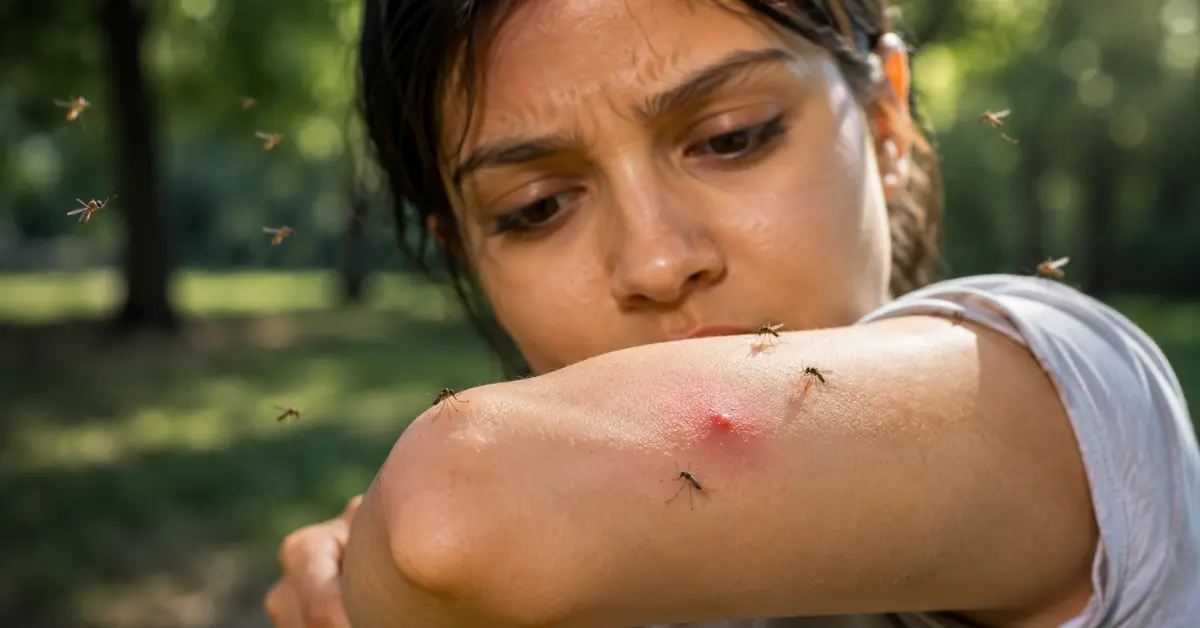

Mosquitoes bite some people more often because every person releases a different combination of body odor, skin chemicals, carbon dioxide, heat and moisture. Mosquitoes detect these signals before they land and some combinations attract them much more strongly than others.
Blood type may play a small role in certain mosquito species but current evidence does not support the popular idea that mosquitoes simply prefer “sweet blood.” Research points more strongly toward the chemical scent produced by a person’s skin.
Mosquitoes Start Tracking You Before They Get Close
A mosquito does not randomly land on a person and then decide whether to bite. It begins collecting sensory information while it remains at a distance.
Female mosquitoes that seek blood combine several signals rather than relying on one special human trait. The process usually begins when they detect carbon dioxide released through breathing.
Carbon dioxide can activate a resting mosquito and encourage it to fly toward a possible host. As it approaches, the mosquito begins using additional clues, including:
- Human body odor
- Skin temperature
- Moisture and humidity near the body
- Visual contrast
- Movement
- Heat and infrared radiation
Researchers describe mosquito host-seeking as a coordinated sensory process. Carbon dioxide may start the search, but human odor often helps the mosquito choose where to land once it comes closer.
This sensory sequence also explains why one factor alone rarely determines who gets bitten. A mosquito may notice your breathing first, follow your odor and then use heat to select an exposed part of your body.
Also Read: Fridge Sweating Outside During Monsoon Safety Guide
Your Skin Produces a Distinct Chemical Signature
Every person carries a unique scent profile. You may not notice it, but your skin constantly releases a complex mixture of chemical compounds.
These compounds come from sweat, natural skin oils and substances created when bacteria living on the skin break down those secretions. The exact mixture differs between individuals because genetics, hormones, skin condition, microbial communities and daily habits all influence it.
Mosquitoes can detect many of these airborne chemicals.
One major study compared people who consistently attracted large numbers of Aedes aegypti mosquitoes with people who attracted far fewer. Researchers found that the highly attractive participants produced greater amounts of certain skin-derived carboxylic acids.
The attraction also remained surprisingly consistent during repeated testing. People who strongly attracted mosquitoes at the beginning often continued to attract them later, suggesting that some people carry a relatively stable mosquito-attracting scent profile.
Carboxylic acids occur naturally in human skin secretions. Having more of them does not mean that someone has poor hygiene or an unhealthy body. They form part of normal human skin chemistry.
A person can therefore shower regularly, wear clean clothes and still attract more mosquitoes than everyone else nearby.
Also Read: AC Dry Mode All Night During Monsoon Safety Guide
Skin Bacteria Help Shape the Odor Mosquitoes Detect
Your skin hosts communities of bacteria that help transform sweat and natural oils into volatile odor molecules.
Different people carry different combinations and quantities of these microorganisms. As a result, two people can produce noticeably different chemical scent profiles even when they use the same soap, eat similar foods and live in the same environment.
Mosquitoes do not necessarily respond to the strength of an odor alone. They may respond to the proportions of specific compounds within that odor.
One chemical may attract a mosquito at a certain concentration but have little effect at another. A blend of several compounds may also create a stronger signal than any individual substance.
Scientists continue to study which combinations matter most because mosquito species do not all behave in exactly the same way. A chemical blend that attracts an Aedes mosquito may not produce the same response in an Anopheles or Culex mosquito.
This variation helps explain why someone may suffer frequent bites in one location or season but experience fewer bites elsewhere.
Carbon Dioxide Can Make Some People Easier to Find
Every person releases carbon dioxide while breathing, but people do not all release exactly the same amount.
Body size, physical activity and metabolic rate can affect carbon dioxide output. Someone who has recently exercised may breathe faster and release a larger plume that mosquitoes can detect.
Carbon dioxide does not fully explain why mosquitoes prefer one person over another. It mainly acts as an alert that a possible host sits nearby.
Once the mosquito follows that signal, skin odor, heat and other close-range cues help it decide whether to approach and land.
This means that a person who releases more carbon dioxide may become easier to locate, but the mosquito may still prefer someone else after comparing their skin scents.
Also Read: How to Reduce Indoor Heat During El Niño Conditions
Exercise Can Strengthen Several Mosquito Signals at Once
People often notice more mosquitoes after walking, running, gardening or working outdoors. Physical activity can strengthen several host signals simultaneously.
Exercise can increase:
- Breathing and carbon dioxide output
- Body temperature
- Sweating
- Moisture around the skin
- Movement that improves visual detection
- The release of sweat-related odor compounds
The mosquito does not respond to exercise as a single attraction factor. Instead, exercise makes the entire human signal easier to detect.
Sweat contains compounds that can contribute to mosquito attraction, while skin bacteria can convert components of sweat into additional odor molecules. Warm, moist skin can also help a mosquito identify a suitable landing area.
Cooling down, changing sweaty clothing and washing exposed skin may reduce some temporary signals. These steps cannot completely hide a person whose natural skin chemistry strongly attracts mosquitoes, but they may reduce the intensity of the scent plume after physical activity.
Mosquitoes Can Detect Body Heat and Infrared Radiation
Mosquitoes have long been known to respond to warmth at close range. Newer research has shown that Aedes aegypti mosquitoes can also use thermal infrared radiation as part of their host-seeking system.
Infrared radiation from a warm body did not strongly attract mosquitoes when researchers presented it alone. However, when mosquitoes also detected human odor and carbon dioxide, infrared information significantly strengthened their movement toward a possible host.
This shows how mosquitoes combine senses rather than treating heat as an independent signal.
A warm person may therefore become more noticeable when mosquitoes have already detected breath and body odor. This may contribute to increased attention after exercise or during warm, humid conditions.
Does Blood Type Decide Who Gets Bitten?
Blood type receives far more attention online than the available evidence justifies.
Some laboratory studies have reported preferences for particular blood groups. However, different experiments have produced different results, and mosquito species may respond differently. Laboratory feeding behaviour also does not always reflect how a mosquito chooses between complete human hosts in a natural environment.
A mosquito must locate and land on a person before it can drink blood. At that stage, it mainly responds to external signals such as breath, odor, warmth and moisture.
Researchers continue to debate whether blood-group-related compounds in skin secretions influence attraction. Reviews of the evidence describe the relationship as uncertain and sometimes contradictory.
Blood type may contribute to attraction under some circumstances, but it cannot explain the entire pattern. Skin chemistry currently provides a stronger explanation for why certain people repeatedly act as mosquito magnets.
Clothing Can Make You More Visible
Mosquitoes also use vision, especially after carbon dioxide or odor has activated their host-seeking behaviour.
Research involving Aedes aegypti suggests that mosquitoes can respond to darker objects and certain longer wavelengths of visible light. Dark clothing may create stronger contrast against the surrounding environment, making a person easier to follow.
Clothing colour does not override skin odor or carbon dioxide. A mosquito will not necessarily ignore an attractive person simply because that person wears a light shirt.
However, lighter clothing may reduce one part of the combined signal, particularly when mosquitoes actively search during daylight.
Loose, long-sleeved clothing also provides a physical barrier. Thin or tight material may offer less protection because some mosquitoes can bite through fabric that sits directly against the skin.
Soap and Fragrance Can Change Your Scent in Unexpected Ways
People often assume that strong perfume attracts mosquitoes while unscented soap repels them. The relationship appears more complicated.
Soap changes the chemicals present on the skin and adds fragrance compounds of its own. A 2023 study found that washing with certain soaps changed mosquito attraction, but the effects depended on both the soap and the individual using it.
The same product did not affect every person in the same way. Some combinations increased attraction, while others reduced it.
This happens because soap does not completely replace a person’s natural odor. It mixes with the existing skin chemistry and produces a new chemical profile.
A product marketed as floral or natural does not automatically attract mosquitoes, and a fragrance-free product does not guarantee protection. Personal observation may help you notice whether bites increase after using a particular lotion, soap or scented product, but proper mosquito repellent offers much more reliable protection.
Food Does Not Offer a Reliable Explanation
People commonly blame bananas, sugar, garlic, spicy food or vitamin levels for mosquito bites. Researchers have explored diet-related theories, but evidence remains limited and inconsistent.
Food can affect body odor in subtle ways, so researchers cannot completely rule out every dietary influence. However, no ordinary food reliably turns someone into a mosquito magnet or makes a person invisible to mosquitoes.
Garlic, vitamin B supplements and other home remedies should not replace proven protection. Even when someone notices fewer bites after changing their diet, weather, mosquito species, clothing and exposure time may provide better explanations.
The strongest evidence still points toward a combination of natural skin chemistry, carbon dioxide, body heat and environmental conditions.
Can You Stop Being a Mosquito Magnet?
You may not be able to permanently change the skin chemistry that makes you attractive, but you can prevent many mosquitoes from reaching or biting you.
The most reliable steps include:
- Apply a properly registered insect repellent according to its label.
- Choose products containing proven active ingredients such as DEET, picaridin, IR3535, oil of lemon eucalyptus, PMD or 2-undecanone where appropriate.
- Wear loose-fitting long sleeves and long trousers.
- Use permethrin-treated clothing or gear, but do not apply permethrin directly to your skin.
- Use window and door screens to keep mosquitoes outside.
- Empty, cover or clean containers that collect standing water.
- Change sweaty clothing after outdoor exercise.
- Consider lighter clothing when mosquitoes remain active around you.
Health authorities recommend registered repellents and protective clothing because these methods provide more dependable protection than attempts to change body odor through food or homemade mixtures.
Removing standing water will not make your body less attractive, but it can reduce the number of mosquitoes developing near your home.
Why One Person May Still Receive Most of the Bites
Mosquito attraction depends partly on comparison.
When several people sit together, a mosquito can respond to the strongest available combination of scent, carbon dioxide, warmth and visual cues. One person does not need to possess an unusually powerful signal in absolute terms. That person only needs to appear more attractive than the others nearby.
The result can also change with circumstances. After exercise, a person may release more heat and carbon dioxide. A new soap may alter skin odor. Dark clothing may increase visibility. Wind may carry one person’s scent plume more directly toward mosquitoes.
At the same time, stable differences in skin chemistry can make the same individual receive more bites repeatedly across many situations.
What Mosquitoes Actually Detect Before They Land
Mosquitoes do not choose people according to one simple rule. They build a sensory picture from breath, body odor, warmth, moisture, movement and visual contrast.
Among these signals, individual skin chemistry appears to explain much of the persistent difference between people. Some bodies naturally release chemical blends that mosquitoes find easier or more rewarding to follow.
You may not be able to change that biological signature completely. However, repellent, protective clothing and mosquito control can interrupt the search before the mosquito reaches your skin.
Frequently Asked Questions
Why do I receive more bites after exercising?
Exercise increases breathing, body heat, sweat and movement. These changes strengthen several signals that mosquitoes use to find and approach people.
Can mosquitoes learn to prefer one person?
Research shows that some people remain consistently more attractive over time because their skin chemistry remains relatively stable. The mosquito does not need to learn that person’s identity; it responds to the chemical signals the person continues to produce.
Does wearing perfume attract mosquitoes?
A fragrance can change how mosquitoes respond to you, but its effect depends on its chemical ingredients and how they interact with your natural scent. Perfume does not universally attract every mosquito species.
Does showering prevent mosquito bites?
Showering can remove sweat and temporarily alter skin odor, especially after exercise. It cannot permanently remove the natural chemical profile produced by your skin, and it does not provide the protection of a registered repellent.
Do mosquitoes prefer people with sweet blood?
Scientists do not recognise “sweet blood” as an established reason for mosquito attraction. Mosquitoes locate people through external signals before they access the blood. Skin odor, carbon dioxide and heat provide stronger explanations.
