
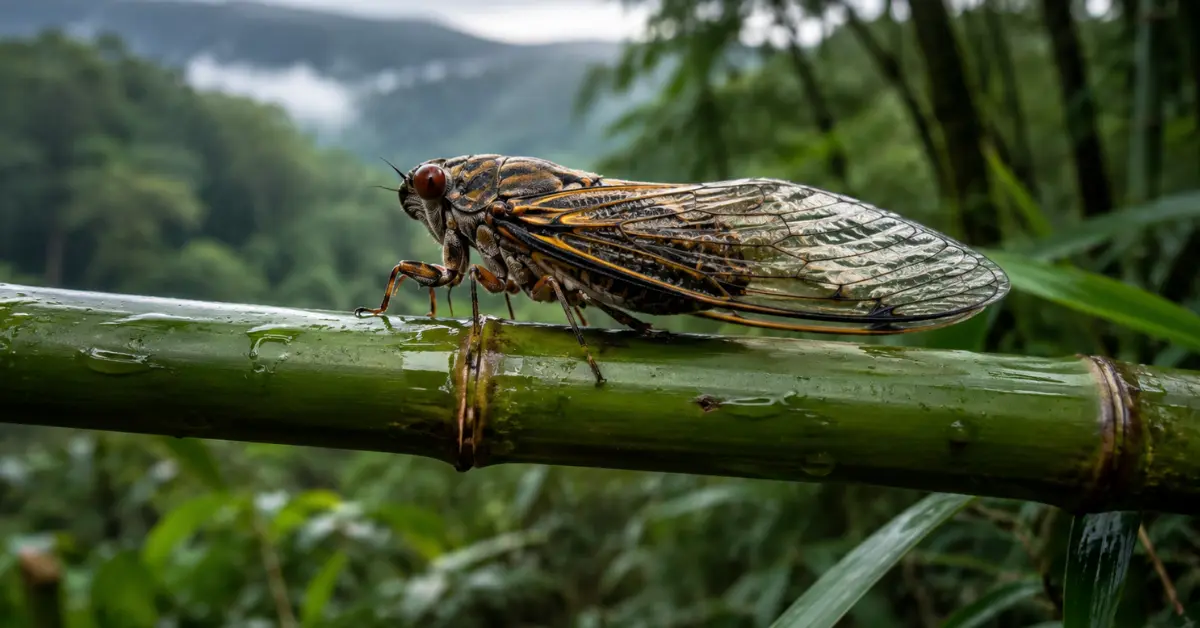

Every four years, football supporters begin counting the days until the FIFA World Cup. At almost the same time, communities in parts of Northeast India wait for a very different event: the return of thousands of cicadas from beneath the forest floor.
The insect, scientifically known as Chremistica ribhoi, follows a remarkably regular four-year emergence cycle. Its appearances repeatedly coincide with FIFA World Cup years, which inspired its popular name—the “World Cup cicada.”
The football tournament does not cause the insects to emerge. The cicadas follow a biological schedule shaped by their development underground and the seasonal signals they receive from the surrounding forest. Their connection with football comes from the shared four-year rhythm.
Scientists first described the species in 2013 after studying mass emergences in Meghalaya’s Ri-Bhoi district. A newly documented 2026 sighting in the Rani-Garbhanga-Basistha forest landscape of Assam now suggests that its distribution reaches beyond the places where researchers originally studied it. The finding also raises important questions about how widely the species lives, how its separate populations remain synchronised and what environmental changes could disrupt its unusual life cycle.
What Is the World Cup Cicada?
The World Cup cicada belongs to the cicada family, a group of insects known for the loud calls males produce during their brief adult lives.
Researchers named the species Chremistica ribhoi after Ri-Bhoi district in Meghalaya. Local communities commonly call it Ñiangtaser, also written as Niangtaser.
Although people in the area had known about the insect for generations, science formally recognised it much later. Entomologist Sudhanya Ray Hajong began investigating the cicada after receiving a specimen in 2006 and hearing that it returned only once every four years.
Researchers waited for the next mass appearance to verify the pattern. The cicadas returned in 2010, supporting the community’s observations. Hajong and Salmah Yaakop formally described the species in a 2013 paper that documented its physical characteristics and periodic mass emergence.
Most cicadas spend a large part of their lives underground, but adults from ordinary cicada populations may appear every year because different generations mature at different times. Periodical cicadas behave differently. Most members of a local population develop on the same schedule and emerge together after a fixed number of years.
Chremistica ribhoi stands out because it follows a four-year cycle. The best-known periodical cicadas, found in North America, follow much longer 13-year or 17-year schedules.
Also Read: Fridge Sweating Outside During Monsoon Safety Guide
Why Does It Appear During the FIFA World Cup?
The cicada and the FIFA World Cup operate on separate schedules that happen to match.
FIFA normally holds its men’s World Cup every four years. The World Cup cicada also completes its underground developmental cycle over approximately four years before large numbers emerge.
People living near the insect’s emergence sites noticed the repeated overlap. The connection became part of local memory: when the cicadas returned, another World Cup had arrived.
In Saiden village in Meghalaya, residents have described the insects and the football tournament as parts of the same calendar. The community began holding the Niangtaser Festival in 2010, combining local food, cultural traditions, conservation awareness and football activities during the cicada’s emergence season.
The timing has attracted greater attention in 2026 because the insects have returned during another World Cup year. FIFA has scheduled the 2026 tournament’s final for July 19 at New York New Jersey Stadium.
However, the cicadas do not detect football matches, tournament dates or human calendars. Their bodies respond to biological development and environmental cycles.
What Happens During the Cicada’s Four Years Underground?
The adult cicada represents only a short stage in a much longer life.
After mating, female cicadas lay eggs in plant tissue. The eggs hatch, and the young nymphs travel down into the soil. They remain underground while passing through several developmental stages.
Like other cicadas, the nymphs use specialised mouthparts to feed on fluid from plant roots. Research and field observations of Chremistica ribhoi associate the species particularly closely with bamboo-rich habitats.
The insects continue developing below ground while the seasons change above them. They experience repeating shifts in soil moisture, temperature and plant activity as monsoon and dry periods pass.
Once the nymphs reach their final developmental stage, they dig towards the surface. They commonly emerge after dark, climb low plants, bamboo or other vegetation and shed their hard outer skin.
The pale, soft-bodied insect that leaves the old shell must wait while its wings expand and its new exoskeleton hardens. Adults then move into nearby vegetation, where males call to attract females.
This above-ground period lasts only a few weeks. The cicadas mate, reproduce and die, while the next generation begins another four-year underground cycle. General cicada biology follows this progression from egg to underground nymph and finally to a short adult stage.
Also Read: AC Dry Mode All Night During Monsoon Safety Guide
How Does a Cicada Know That Four Years Have Passed?
The insects do not count calendar years in the way people do. They appear to track recurring environmental changes while their bodies continue developing.
Hajong has explained that the nymphs may receive annual signals from changes in rainfall, soil moisture, temperature and the seasonal movement of nutrients through their host plants. Each completed sequence of wet and dry conditions may provide information about the passing year.
After experiencing the required number of seasonal cycles and reaching the correct developmental stage, the nymphs prepare to emerge.
Environmental conditions may also help determine the exact night or period when they leave the ground. Rain softens dry soil, while changes in temperature and moisture can create favourable conditions for emergence.
Scientists still need more research to explain the complete timing mechanism in Chremistica ribhoi. Researchers understand far more about North American periodical cicadas than they do about this rare Indian species.
It would therefore be inaccurate to claim that scientists have identified one internal clock or single environmental trigger that controls every World Cup cicada. The timing likely involves a combination of physical development, inherited biological programming and repeated seasonal cues.
The cicadas also need to emerge at roughly the same time. A scattered appearance would leave individual insects more exposed to predators and make it harder for adults to find mates.
Why Do So Many Cicadas Emerge Together?
Mass emergence gives periodical cicadas a survival advantage.
Birds, reptiles, mammals and other animals can eat cicadas. When only a few insects appear, predators may consume a large proportion of them. When thousands or millions emerge during a short period, predators cannot catch every individual.
This strategy does not protect each cicada. Many still become food. However, enough adults survive to mate and produce the next generation.
Scientists often describe this strategy as predator satiation. The sudden abundance overwhelms the feeding capacity of local predators, allowing part of the population to complete its reproductive cycle.
Synchronous emergence also places adult males and females in the same habitat at the same time. That concentration increases their chances of finding mates during their short lives above ground.
Research on other periodical cicadas strongly supports the importance of synchronised emergence, although scientists should study the Indian species directly before assuming that every mechanism works in exactly the same way.
What Is Important About the 2026 Assam Sighting?
Researchers previously associated the most studied World Cup cicada populations with parts of Ri-Bhoi district in Meghalaya.
In 2026, researchers documented the insect in the Rani-Garbhanga-Basistha forest landscape near Guwahati in Assam. The record gives scientists evidence of a population outside the better-known Meghalaya emergence sites.
The finding does not necessarily mean that the cicadas recently moved into Assam. The population may have lived there for many generations without receiving formal scientific documentation.
Earlier observations had mentioned cicadas in Assam, but researchers lacked the kind of location-specific evidence needed to establish their distribution confidently. For that reason, the safest interpretation describes the 2026 finding as a significant documented record from the Rani-Garbhanga-Basistha landscape rather than proof of a sudden migration.
Its location also makes ecological sense. The forest landscape lies close to the Meghalaya border and contains habitats that could support species shared across the state boundary. Forest ecosystems follow terrain, vegetation and climate rather than administrative maps.
The new record may lead researchers to search other suitable habitats between known Meghalaya sites and the Assam location. Additional surveys could reveal whether the populations form a connected distribution or survive in separate forest pockets.
Scientists also need to determine whether the Assam cicadas follow exactly the same emergence schedule as the better-known Ri-Bhoi population.
Also Read: How to Reduce Indoor Heat During El Niño Conditions
What Could the Assam Record Reveal?
The Assam sighting may help answer several unresolved questions about the species.
First, it could improve estimates of the cicada’s true geographic range. Researchers cannot plan effective conservation while they know only a small part of an insect’s distribution.
Second, comparisons between Meghalaya and Assam populations could show whether the insects use the same host plants, emerge under the same weather conditions and follow the same four-year timing.
Third, genetic studies could reveal whether the populations regularly exchange individuals or have remained separated for long periods.
Finally, the finding reinforces the biological importance of the Rani-Garbhanga-Basistha landscape. Earlier biodiversity work in Garbhanga documented hundreds of butterfly and vertebrate species while also identifying major gaps in knowledge about lesser-studied wildlife.
Small insects often receive less research attention than mammals and birds, even though they perform essential ecological roles and can respond quickly to habitat disturbance.
Why Does the World Cup Cicada Need Its Forest Habitat?
The cicada depends on a functioning forest throughout almost its entire life.
Its nymphs need living roots for food while they remain underground. They also require suitable soil that allows them to tunnel, develop and eventually reach the surface.
Above ground, adults need vegetation where they can complete their transformation, gather, call, mate and lay eggs.
Removing trees or bamboo can therefore affect more than one brief emergence season. Damage to the habitat may interrupt a generation that has already spent several years developing below ground.
Forest fires, clearing, construction, soil disturbance and intensive harvesting can all place pressure on local populations. Researchers have expressed concern that habitat changes may leave the cicadas confined to increasingly isolated forest pockets.
Because the insects remain hidden for most of their lives, a population can disappear without attracting immediate attention. People may recognise the loss only when an expected emergence year arrives and the forest stays quiet.
Are World Cup Cicadas Dangerous?
World Cup cicadas do not hunt people, inject venom or spread through homes like common household pests.
Their large numbers and loud calls can surprise people who have never witnessed a mass emergence, but the insects focus on reproduction rather than attacking humans.
Cicadas have mouthparts designed to obtain plant fluids. They do not possess the biting jaws or stingers associated with many defensive insects.
Their emergence can also benefit the surrounding ecosystem. Cicadas provide a temporary food supply for birds, reptiles and other animals. Their underground movement can alter the soil, while their bodies return nutrients to the environment after they die.
People should avoid unnecessarily spraying insecticides across natural emergence sites. Broad chemical treatment could harm the cicadas as well as butterflies, bees and other insects living in the same habitat.
When Will the World Cup Cicada Return?
A population that maintains the same four-year schedule would be expected to produce another major emergence around 2030.
That date remains an expectation rather than a guarantee. Local weather, habitat disturbance, population differences and incomplete survey information could affect what researchers observe at individual sites.
The most important work will happen before the next emergence. Scientists can map the 2026 locations, document habitat conditions, study adult cicadas and monitor the forests where the next generation now lives underground.
The World Cup nickname gives the insect worldwide appeal, but its scientific importance extends beyond football. Its four-year cycle offers researchers a rare opportunity to study biological timing, synchronised behaviour and the survival of specialised insects in changing forests.
The new Assam record has made that opportunity larger. It suggests that Northeast India may still contain overlooked populations—and that scientists have only begun to understand how this unusual cicada reads the passing years beneath the soil.

5 thoughts on “India’s World Cup Cicada and Its Four-Year Life Cycle”