
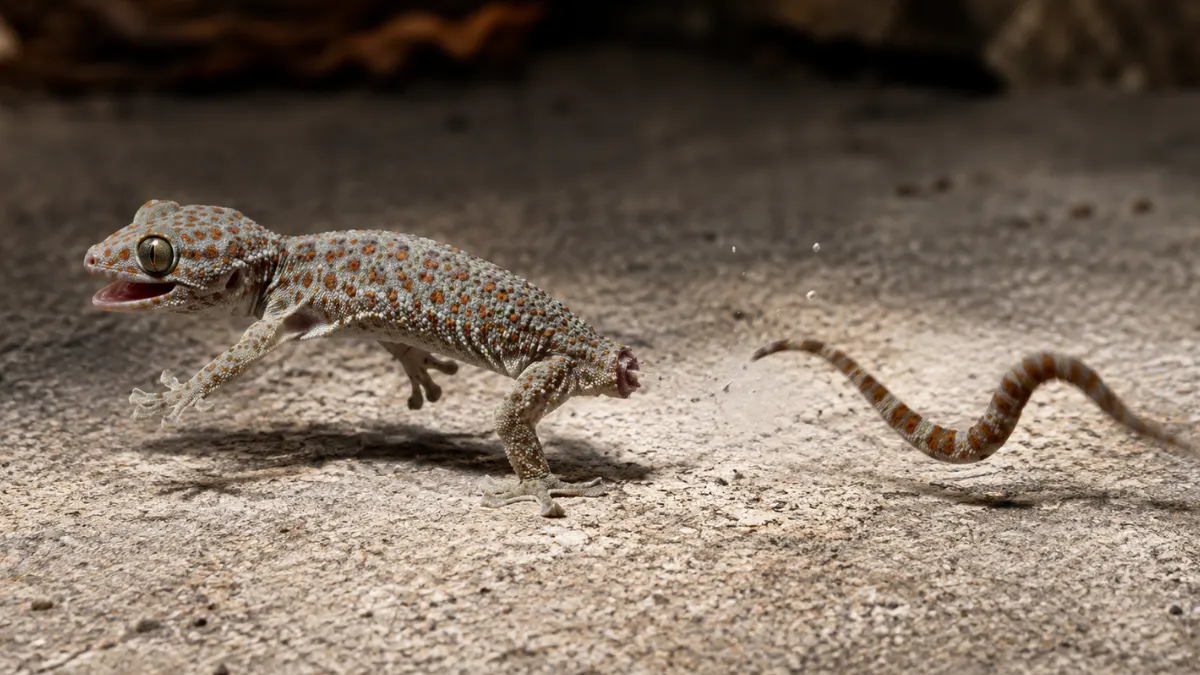

A lizard’s detached tail keeps moving because nerve circuits inside the tail continue activating its muscles after separation. The tail does not need fresh instructions from the lizard’s brain to produce these temporary movements.
The detached tail still contains nerves, muscles and a limited supply of stored energy. Together, they can make it swing, twist, jump or flip for several minutes while the lizard escapes from danger.
How Can a Detached Lizard Tail Move Without the Brain?
The brain usually coordinates an animal’s intentional movements. However, some repeated movement patterns can be produced by smaller networks of nerve cells located closer to the muscles.
A lizard’s tail contains spinal tissue, peripheral nerves and groups of muscles. When the tail separates from the body, these structures remain inside the detached section.
Local neural circuits can continue sending electrical signals to the tail muscles. Different muscle groups contract in sequence, causing the tail to bend from one side to the other.
This activity can continue even though the connection between the tail and the brain has been completely broken.
The mechanism resembles an automatic movement program. Once activated, the local nerves can produce repeated contractions without waiting for the brain to command each individual motion.
The detached tail also retains a small amount of chemical energy inside its cells. This energy allows the muscles to contract temporarily, even though the tail no longer receives fresh oxygen and nutrients through the lizard’s bloodstream.
The movement stops only after nerve activity weakens, the muscles become exhausted and the remaining energy supply runs out.
Is the Movement More Than a Simple Muscle Spasm?
A detached lizard tail does not always produce only weak or random twitching.
Researchers studying detached leopard gecko tails have observed organised patterns that include rhythmic side-to-side swinging, sudden jumps, flips and changes in movement intensity.
Some movements repeat in a fairly regular rhythm. Others appear unpredictable and may interrupt the regular swinging pattern without warning.
This complexity suggests that the tail’s local nervous system can coordinate several kinds of movement rather than producing one simple reflex.
The rhythmic movements probably come from neural circuits that activate muscles on alternating sides of the tail. When the muscles on one side contract, the tail bends in that direction. Contraction on the opposite side then bends it back.
Sudden flips and jumps may involve several muscles contracting at nearly the same time. These stronger contractions can lift part of the tail from the ground or cause it to roll over.
The tail therefore behaves like a temporary, self-contained movement system. It cannot think or decide where to go, but its remaining nerves can still organise muscular activity.
Why Does the Tail Jump, Twist and Change Direction?
Unpredictable movement makes the detached tail much more noticeable to a predator.
A tail that only produced a small, regular twitch might quickly be ignored. A tail that suddenly jumps, curls or changes direction looks more like active prey.
Detached gecko tails have also been observed changing their movement patterns after contacting the ground or nearby objects.
Sensory feedback may help modify some of these movements. Nerves inside the tail can detect pressure, stretching and contact, although scientists have not identified every neural mechanism involved.
This does not mean the tail understands its surroundings. The response is automatic, similar to a reflex that changes muscle activity after physical contact.
The irregular movement also makes it difficult for a predator to predict where the tail will go next. A cat, bird, snake or other hunter may continue watching or attacking it instead of following the escaping lizard.
Why Does a Moving Tail Help the Lizard Escape?
Many small lizards use tail loss as an emergency defence against predators.
When a predator grabs or approaches the lizard, the tail can separate from the body. The detached section then begins moving strongly while the lizard runs in another direction.
The movement attracts attention because predators naturally react to motion. A wriggling tail can appear to be the most active part of the prey.
The predator may bite, hold or chase the detached tail while the lizard reaches a crack, wall opening, plant or other hiding place.
This defence works especially well when the predator has already caught the lizard by its tail. The tail separates and remains with the predator, while the rest of the lizard escapes.
The tail’s movement does not need to last for a long time. Even a few seconds of distraction can give a small lizard enough time to disappear.
Irregular jumps and twists may extend that distraction because they continue triggering the predator’s hunting response.
Tail loss is therefore not an accident in many species. It is a specialised survival strategy that turns a lost body part into a temporary moving decoy.
How Long Can a Detached Lizard Tail Keep Moving?
A detached tail may continue moving for several minutes, but there is no single duration that applies to every lizard.
In laboratory observations, detached leopard gecko tails produced complex movements for up to approximately 30 minutes. This should not be treated as the normal duration for every species.
The length of time depends on several factors, including the species, tail size, temperature, physical condition and amount of stored energy in the muscles.
A larger or healthier tail may contain more available energy than a small or weakened one. Warmer temperatures can also increase nerve and muscle activity because lizards depend on external heat to regulate many body processes.
More vigorous movement may use the remaining energy faster. A tail that jumps and flips repeatedly can become exhausted sooner than one producing slower contractions.
The movement normally becomes weaker over time. Strong swings may turn into small twitches before the tail becomes completely still.
Once the cells lose their ability to produce electrical signals and muscle contractions, the movement cannot restart.
Is the Detached Tail Still Alive or Conscious?
Some cells and tissues inside the detached tail remain metabolically active for a limited period. However, the tail is not a separate conscious animal.
It has no brain and cannot think, feel fear, choose a direction or understand what is happening.
The movement comes from automatic nerve activity and muscle contractions. It does not prove that the tail has awareness.
The tail also cannot survive independently. It no longer receives blood, oxygen or nutrients from the lizard’s body.
Its cells briefly rely on the oxygen and chemical energy already available inside the tissue. Some energy can also be produced temporarily without a normal oxygen supply through anaerobic metabolism.
This limited process cannot continue indefinitely. Waste products accumulate, energy levels fall and the muscles eventually stop responding.
The tail may therefore contain living tissue while it is moving, but it is no longer a complete living organism.
How Does a Lizard Release Its Tail?
The ability to deliberately release a body part is called autotomy.
Many geckos, skinks, anoles and other lizards have specialised weak zones inside their tails. These areas are commonly called fracture planes.
When the lizard faces severe danger, muscles around one of these zones can help separate the tail. The break happens along a structure that is already adapted for release.
This controlled separation differs from an ordinary injury in which tissue tears unpredictably.
The blood vessels near the separation point can constrict quickly, helping reduce blood loss. Muscles and tissues around the wound also help close the exposed area.
A lizard does not usually release its tail because of every small disturbance. Tail loss carries major costs, so it is mainly used when the animal faces a serious threat.
People should never grab a lizard by its tail or deliberately frighten it to observe this behaviour. The tail is valuable for movement, balance, communication and energy storage.
Does Every Lizard Have This Ability?
Not every lizard can release its tail in the same way.
Many small geckos and skinks have well-developed fracture planes and can perform autotomy relatively easily. Other lizards have limited tail-shedding ability, while some cannot deliberately detach their tails at all.
The importance of the tail also differs among species.
Some lizards use the tail to balance while climbing or running. Others use it while swimming, jumping, displaying to mates or defending themselves.
Species with thick tails may also store important fat reserves inside them. Losing the tail can remove a substantial amount of stored energy.
For this reason, autotomy represents a trade-off. The lizard survives the immediate attack but loses a useful part of its body.
The ability remains valuable because escaping without a tail is still better than being captured by a predator.
Will the Lizard Grow Another Tail?
Many lizards that can release their tails are also able to grow replacements.
However, the regenerated tail is usually not identical to the original one.
The original tail contains a chain of bones called vertebrae. A replacement tail commonly develops around a long tube of cartilage instead of rebuilding the same series of bones.
The new tail may also differ in colour, scale pattern, thickness, flexibility or length. It can look smoother or more rounded than the original.
Regeneration requires considerable energy. The lizard must repair the wound, produce new tissue and maintain normal activities at the same time.
The process may take weeks or months, depending on the species, age, diet, health and environmental conditions.
A regenerated tail can restore useful movement and balance, but it does not completely erase the cost of the original loss.
Is Tail Loss Related to Other House-Gecko Behaviours?
Tail autotomy is a defensive response and should not be confused with an ordinary fall.
House geckos normally cling to walls and ceilings using microscopic structures on their toe pads. Dust, moisture, loose surfaces and sudden disturbances can sometimes affect that grip, as explained in why house geckos sometimes fall from the ceiling.
Their familiar nighttime clicking is also a separate behaviour. House geckos use sounds during communication, territorial encounters and courtship, which is covered in why house geckos make clicking sounds at night.
A gecko may use climbing, vocal communication and tail loss in different situations. Each behaviour solves a separate survival or social problem.
What Does the Moving Tail Really Show?
A detached lizard tail keeps moving because it retains working nerves, muscles and temporary energy after separation.
Local neural circuits can coordinate rhythmic swings and sudden flips without receiving commands from the brain. The unpredictable movement distracts predators and gives the lizard a valuable opportunity to escape.
The movement eventually stops as the disconnected tissue loses energy and the muscles can no longer respond.
What appears to be a strange after-death movement is actually a highly specialised defence system. For a threatened lizard, a moving detached tail can mean the difference between being caught and surviving.
