
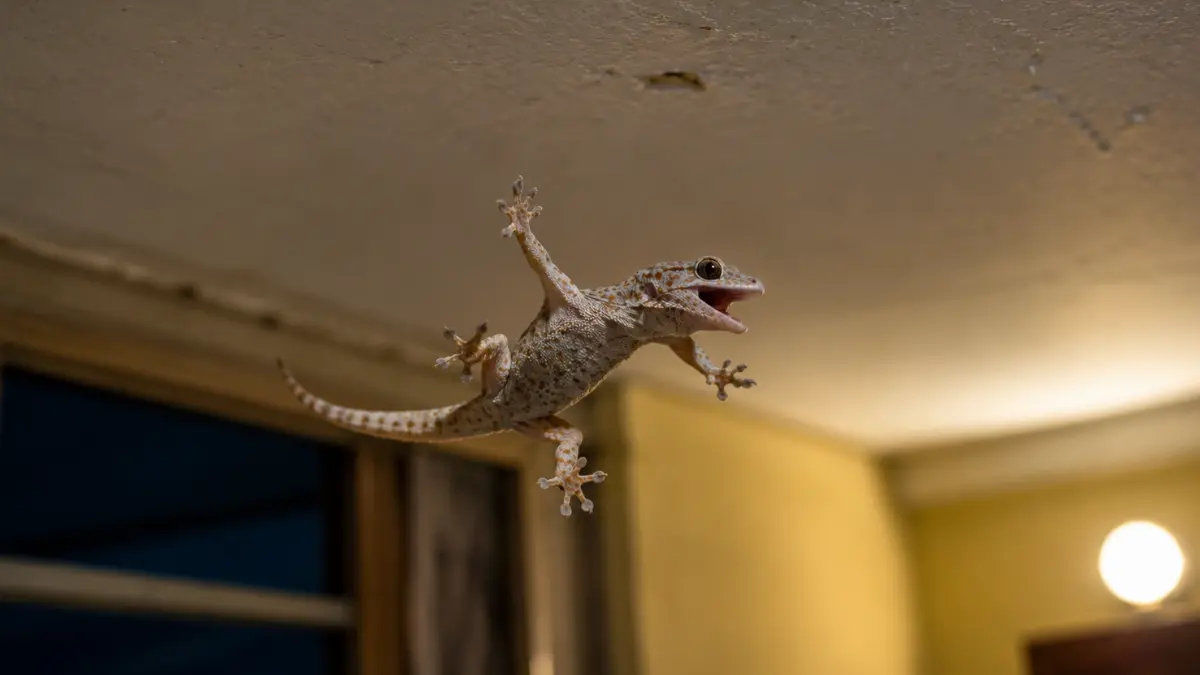

Why do house geckos sometimes fall from the ceiling when they can normally walk upside down? A gecko can fall when its adhesive toes fail to create enough secure contact with the surface. Wet toe pads and certain surface textures can sharply reduce adhesion, while dust or unstable ceiling material may also interfere with its grip.
Fast movement or a poorly placed step could contribute to a slip, although researchers have not measured the most common causes of gecko falls inside homes.
Gecko feet are powerful, but they are not permanently glued to walls and ceilings. The animal must actively engage and release its toes during every step.
This explanation draws mainly on experiments involving Tokay geckos and other pad-bearing species. House geckos use the same general dry-adhesion system, but their exact toe structure and performance can differ between species.
How Do Geckos Normally Stay on Ceilings?
Many climbing geckos have broad toe pads covered with microscopic hair-like structures called setae.
Each seta divides into much smaller tips called spatulae. These tiny structures create a vast number of contact points when the gecko places its toes against a wall or ceiling.
The tips approach the surface extremely closely. Weak molecular attractions between the toe structures and the surface then combine to produce a strong grip.
One microscopic contact provides little force by itself. Large numbers of contacts acting together can support the gecko’s body with a considerable safety margin.
Gecko feet do not work like suction cups. They do not need a vacuum, sticky mucus, or wet glue.
The system depends on close contact, correct toe orientation, and force applied in the right direction. The gecko actively controls these conditions as it climbs.
This allows it to cross glass, painted walls, leaves, bark, and many other surfaces without leaving a sticky substance behind.
However, anything that prevents close contact can reduce the number of adhesive structures working at the same time.
Why Can a Gecko’s Grip Fail?
A gecko’s grip can weaken when its toes do not engage properly with the surface.
The animal normally places its toe pads against the ceiling and applies force in a direction that activates the adhesive structures. It must repeat this process as each foot moves forward.
A foot may touch the surface without creating full adhesive contact. If several feet make weaker contact at the same time, the remaining attached toes must support more of the animal’s weight.
Experiments have directly shown that wet toe pads and certain surface patterns can reduce gecko adhesion. Dust particles can also contaminate the pads and temporarily interfere with contact.
Other household explanations remain mechanically plausible but less directly studied. A ceiling may contain powdery plaster, loose paint, moisture, or uneven material that fails beneath the gecko’s feet.
Rapid turns could also expose an already weak attachment. However, this should not be treated as proof that hunting or running causes most falls.
A single fall does not mean the gecko’s adhesive system has permanently failed. Its grip may return after the pads dry, shed loose particles, or reach a more suitable surface.
Can Water Make Gecko Feet Slip?
Water can weaken gecko adhesion, especially when the toe pads become thoroughly wet.
Water may enter the microscopic structures and prevent the adhesive tips from approaching the surface closely enough. This reduces the number of effective contact points.
Experiments with Tokay geckos found that completely wet toe pads produced far less adhesive force than dry pads.
A thin layer of water on a smooth surface can also interfere with grip, particularly if repeated steps cause the toe pads themselves to become wet.
The effect of water depends on the surface’s wettability and physical structure. Wet glass, patterned materials, and water-repelling surfaces do not all produce the same result.
Water does not therefore make every gecko fall immediately. Many species live in humid or rainy environments and move successfully across natural surfaces.
Adhesion can recover as the toe pads dry. Active walking on a dry surface may speed that recovery by helping remove water from the microscopic structures.
This means a gecko that slips on a wet surface may later climb normally again without suffering permanent damage to its feet.
Can Dust or Loose Paint Affect the Grip?
Dust can interfere with the close contact required for gecko adhesion.
Loose particles may attach to the toe pads and occupy space between the adhesive structures and the ceiling. This temporarily reduces the number of contact points available.
Gecko feet have a self-cleaning ability. Repeated steps can transfer many particles from the toes onto the surface.
The cleaning process is not always immediate. A heavily contaminated foot may remain less effective for several steps, especially if the gecko continues moving across a dusty area.
The material beneath the gecko can also fail.
A gecko may remain attached to a small paint flake even as that flake separates from the ceiling. Powdery plaster or loose surface material can produce a similar result.
In such a case, the toe pads may still be gripping successfully. The ceiling material itself has broken away beneath them.
This household explanation is physically reasonable, although it has not been established as one of the most common causes of wild gecko falls.
Does Surface Texture Matter?
Geckos can climb many smooth and rough materials, but their adhesive pads do not perform equally well on every possible surface.
The toe pads must conform closely enough for large numbers of microscopic structures to engage.
Some surface patterns create gaps that prevent the pad from lying flat. Features near the size of the toes or adhesive structures can greatly reduce the available contact area.
A deeply uneven or sharply changing surface may therefore provide fewer useful attachment points than smooth glass.
The result does not depend simply on whether a surface feels rough to a human hand. The size, spacing, shape, and stability of its features all matter.
Gecko toes are flexible and divided, allowing the animal to adjust different parts of the foot independently.
Depending on the species and surface, claws may provide additional mechanical grip where edges or gaps are available. The claws and adhesive pads can contribute in different ways.
This flexibility allows geckos to move across varied habitats, but it does not guarantee perfect attachment to every painted, patterned, or damaged ceiling.
Can Fast Movement Contribute to a Slip?
Geckos can attach and release their feet extremely quickly while running.
During every step, the animal must engage one set of toes while releasing another. It also balances its body and adjusts direction as it moves.
Rapid turns or lunges could expose a weak attachment if only part of a foot is engaged or if the surface is wet, dusty, or unstable.
This is a mechanical possibility rather than a confirmed explanation for most household falls.
Geckos frequently hunt around artificial lights because moths, flies, mosquitoes, and other insects gather on nearby walls and ceilings.
Artificial light can disrupt the normal flight of moths, leaving insects circling or remaining close to the illuminated area.
A gecko may make sudden movements while following this unpredictable prey. Most of the time, its adhesive system handles those movements successfully.
A fall becomes more plausible when fast motion combines with another problem, such as water, contamination, poor surface contact, or loose material.
The movement alone should not be treated as the proven cause.
Why Do Geckos Not Stay Permanently Stuck?
Gecko adhesion is directional and controllable.
The animal engages its adhesive structures by placing the toes against the surface and applying force in the correct direction.
It releases the foot by changing the angle of the toes and microscopic structures through a rapid movement called digital hyperextension.
This reduces adhesive contact and prepares the foot for the next step.
A permanently sticky foot would make fast movement impossible. The gecko would struggle to run, hunt, escape, or move smoothly between a wall and ceiling.
Its feet must therefore balance two opposite needs. They must create strong attachment when loaded but release quickly when the animal takes another step.
Because attachment must be engaged again during every step, the system still depends on successful contact with the next part of the surface.
The gecko usually spreads the load across several feet. This prevents one poorly placed toe from immediately causing a fall.
However, if several feet lose effective contact together, the remaining attachment may not be enough to support the sudden load.
Can the Tail Help During a Fall?
In some gecko species, the tail helps stabilise the body during climbing and can assist with aerial righting after a fall.
A gecko may press its tail against a wall when the front of its body begins tipping away from the surface. The tail then acts as an extra support point.
During a fall, rapid tail movements can help some geckos rotate their bodies and face the ground before landing.
These abilities do not mean that every house-gecko species uses its tail in exactly the same way. Tail shape, size, and movement differ among species.
The tail also does not prevent every fall. It provides another form of body control after one or more feet begin losing contact.
Walls and ceilings serve as more than climbing surfaces. They also act as feeding and communication spaces where house geckos make clicking sounds at night.
Encounters with other geckos may involve quick turns or repositioning, but scientists have not established social interaction as a leading cause of household falls.
Does Falling Always Injure a Gecko?
A fall does not guarantee injury, but geckos are not immune to harm.
The outcome depends on the species, fall height, landing position, and surface below.
Research on some species has identified aerial-righting and impact-protection mechanisms. These adaptations may help the animal control certain falls, but they do not make every landing harmless.
A fall onto soft vegetation differs from one onto hard tile or a sharp object.
The article should not suggest that a particular height is safe for every gecko. There is no universal harmless falling distance that applies across species and conditions.
Do All House Lizards Have Adhesive Feet?
The phrase “house lizard” can describe several small lizard species found around buildings.
In many tropical regions, it commonly refers to house geckos with expanded adhesive toe pads. Other lizards rely more on claws, limb position, and surface texture.
Those species may climb rough walls or tree trunks but struggle to cross smooth glass or hang upside down from a ceiling.
Adhesive ability also varies among gecko species. Some have highly developed pads, while others have reduced pads or lack the same climbing system.
A gecko can therefore fall even though its feet normally provide a powerful grip. Adhesion depends on dry, stable, close contact that must be actively renewed during every step.
Water, dust, unsuitable surface patterns, and unstable ceiling material can weaken that contact. Rapid movement may contribute when the grip is already poor, but researchers have not identified one universal cause behind household falls.
The occasional slip does not make gecko feet ineffective. It shows that even one of nature’s strongest climbing systems still depends on the condition of the animal, the movement, and the surface beneath its toes.

1 thought on “Why Do House Geckos Sometimes Fall From the Ceiling?”