
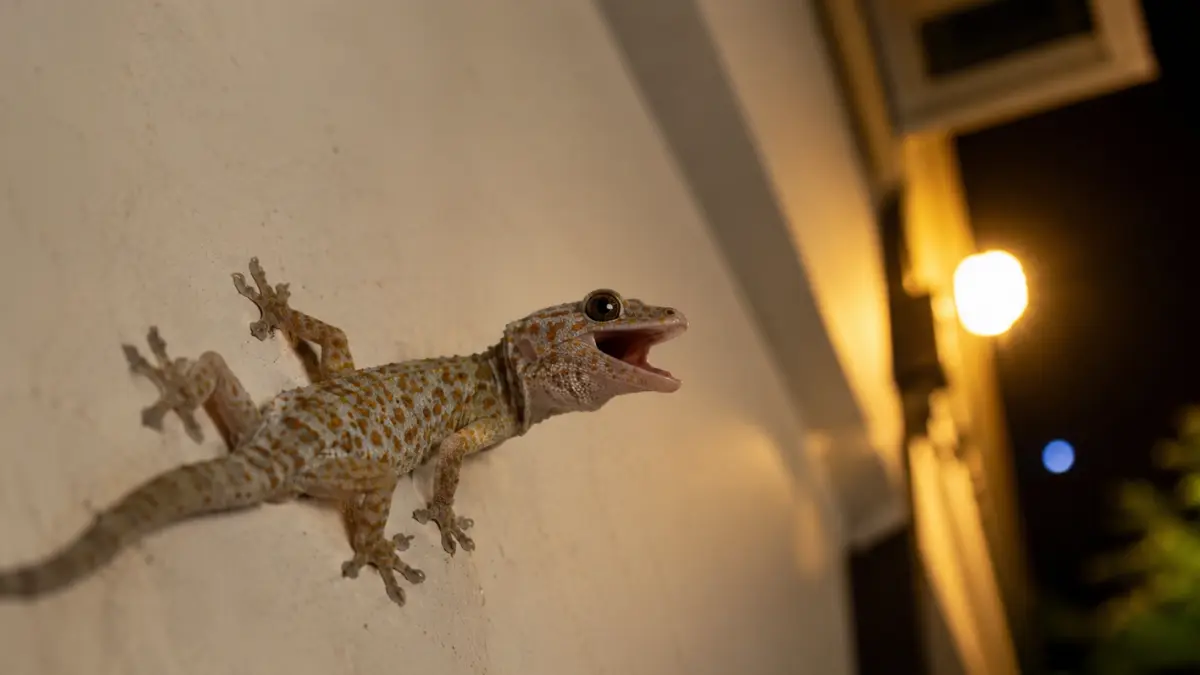

Why do house geckos make clicking sounds at night when most other lizards remain quiet? House geckos click and chirp mainly to communicate with other geckos. In the Asian house gecko, the familiar repeated call comes primarily from adult males and probably supports territorial communication, mate advertisement, or both.
People usually notice the sound after dark because house geckos become active around dusk. They leave daytime shelters, move through feeding areas and encounter other geckos on walls, ceilings, windows, and outdoor surfaces.
This explanation focuses mainly on the Asian house gecko, a highly vocal species commonly found around tropical and subtropical buildings. Other gecko species may produce different sounds and use them in different situations.
Why Do House Geckos Make Clicking Sounds?
House geckos use sound as a form of social communication.
Many lizards rely heavily on movement, body posture, colour, scent, or physical contact. Geckos are unusual because several species also produce sounds that people can clearly hear.
A repeated sequence of clicks or chirps can advertise that a gecko is present. The call may help a male communicate with a nearby female, warn another male that the area is occupied, or perform both functions at the same time.
Researchers have not completely decoded the meaning of every gecko call. The familiar multiple-chirp call appears to work as a broadcast signal, but its exact meaning can depend on the caller, nearby geckos, and the social situation.
Sound is especially useful at night. A gecko may be hidden behind furniture, inside a roof space, near a window frame, or in a dark corner where visual signals would be difficult to see.
A call can travel beyond the animal’s immediate hiding place. This allows geckos to communicate even when walls, shadows, vegetation, or household objects block their view.
House geckos may also live close together where buildings provide warmth, shelter, and a steady supply of insects. Their clicking sounds help them manage these shared spaces without needing constant physical contact.
Are Male or Female Geckos Making the Sound?
Adult males produce most of the loud, repeated calls commonly associated with Asian house geckos.
A male may call after leaving its daytime shelter, while moving through a familiar area, or when another gecko is nearby. The call probably announces the male’s presence to potential mates and competing males.
Studies have found that males may call more frequently when females are present. This suggests that the repeated call can contribute to sexual communication, although it may still carry territorial information at the same time.
Male geckos can also call during aggressive encounters with other males. A close rival may trigger a different, rougher sound than the familiar repeated household chirp.
Adult females did not produce the loud multiple-chirp call in a controlled study of Asian house geckos. Juveniles can produce calls, and separate distress or aggressive sounds have also been described.
This does not mean that every sound inside a house must come from an adult male. However, a loud sequence of repeated clicks is most strongly associated with male Asian house geckos.
The caller may remain hidden throughout the entire sequence. A person can hear several clear notes from a wall or ceiling without being able to identify which gecko made them.
Why Do Geckos Call Mainly at Night?
Asian house geckos are nocturnal. They spend much of the day inside cracks, roof spaces, wall gaps, cupboards, tree bark, or other protected places.
They usually become active around dusk, when they begin leaving daytime shelters and moving through feeding and social areas.
Studies have found strong calling peaks around sunset and, in some populations, shortly before sunrise. The exact timing can differ between locations, seasons, and local conditions.
Calling may increase when geckos first emerge because several individuals begin moving through the same areas. Males may encounter females, rivals, or signs that another gecko is nearby.
Warm conditions can also support greater activity. Geckos depend on external temperatures to regulate their body functions, so they may move and call less during unusually cool periods.
The number of adult males around a building also matters. A single gecko may call only occasionally, while several males sharing feeding and shelter areas can produce repeated bursts of sound.
Night-time silence makes the calls more noticeable to people. A sound that disappears beneath traffic, appliances, voices, and outdoor activity during the day can seem surprisingly loud in a quiet room.
Other animals also become noticeable through night-time communication. Frogs, for example, produce loud choruses after rain when wet conditions create favourable breeding opportunities.
House geckos follow a different pattern. Their calls reflect normal nocturnal activity and social interaction rather than a direct response to rainfall.
What Do the Different Gecko Sounds Mean?
House geckos can produce more than one type of sound. The pattern and situation provide clues about what the gecko may be communicating.
The sounds should not be treated as a fully translated language. Researchers can connect certain calls with particular situations, but they cannot assign a precise human meaning to every click.
A repeated multiple-chirp call is the sound people most often hear at night. Adult males produce it most frequently, and it probably acts as a territorial or sexual broadcast.
The caller may repeat several notes in a regular sequence. People describe the sound in different ways, including clicking, chirping, barking, or “chik-chik-chik.”
A short churr or trill-like sound has been observed during close aggressive encounters between males. This sound differs from the regular broadcast call and appears when the animals interact at close range.
A brief distress sound can occur when a gecko faces an immediate threat or experiences fear. This call is usually shorter and less regular than the repeated male chirp.
A sudden single sound therefore does not always mean the same thing as a calm sequence of repeated clicks.
The gecko’s behaviour can provide additional context. A gecko sitting normally before and after a repeated call is probably communicating with another gecko. One that suddenly struggles, flees, or hides after a short sharp sound may be responding to danger.
People often hear the call without seeing the event that caused it. Two geckos may be interacting behind furniture, above a ceiling panel, or outside a window.
How Do House Geckos Produce the Sound?
House geckos produce their calls through respiratory and vocal structures in the throat.
Each repeated note is accompanied by an exhalation of air from the lungs. The gecko produces a sequence by repeating the process several times in rapid succession.
The animal may show only a small body movement while calling. This is one reason a loud gecko can remain difficult to locate on a dark wall or behind an object.
A person may expect the gecko to open its mouth widely or move dramatically, but the visible movement can be subtle. The sound may seem much larger than the animal producing it.
Call characteristics can vary between individuals. Body size, temperature, age, and social context may influence the pitch, rhythm, or strength of the sound.
Research has found a relationship between body size and important call frequencies in Asian house geckos. This suggests that a call may carry some information about the male producing it.
A nearby gecko may therefore receive more than a simple announcement of presence. The sound could also provide clues about the caller’s identity or physical size.
Scientists still need more research to understand how listening geckos interpret these differences.
Why Do Geckos Gather Near Lights?
House geckos often appear beside bulbs, windows, porch lamps, tube lights, and illuminated walls because these places provide reliable feeding opportunities.
Many nocturnal insects become concentrated around artificial lights. Moths, mosquitoes, flies, beetles, and other small animals may circle the light, land on nearby surfaces, or struggle to maintain normal flight.
Research suggests that artificial lights can disrupt the normal flight control of moths rather than simply attracting them from unlimited distances.
For a gecko, an insect-covered wall becomes an efficient hunting ground.
Several geckos may repeatedly visit the same light because food is easy to find there. When adult geckos share a limited feeding area, social and territorial encounters become more likely.
The light does not directly force the gecko to click. It creates a gathering point where geckos may hunt, notice one another, and communicate.
A male may remain close to a productive feeding wall because it offers both prey and contact with other geckos. Repeated encounters can make clicking sounds more common around windows and outdoor lamps than in quieter parts of a building.
Turning off a light may reduce insect activity in that exact area, but it does not change the gecko’s basic ability or need to communicate.
Why Does the Clicking Suddenly Stop?
A house gecko may stop calling when it detects movement, vibration, light, or a possible threat.
Calling reveals the animal’s location. Remaining silent can make it harder for a predator or approaching person to find the caller.
The gecko may freeze against the wall, move behind furniture, enter a crack, or retreat toward the ceiling. Its flattened body and muted colouring can make it difficult to see once it stops moving.
Several nearby geckos may become quiet at the same time if they detect the same footsteps, shadow, or disturbance.
The clicking may also stop because the social interaction has ended. A rival may move away, a female may leave the area, or the caller may begin hunting instead.
House geckos do not need to call continuously throughout the night. Their communication occurs in short periods shaped by temperature, activity, nearby animals, and location.
A person may hear several calls within a few minutes and then hear nothing for hours. The silence does not necessarily mean that the gecko has left the building.
Do All House Geckos Make the Same Sound?
Different gecko species produce different sounds.
The Asian house gecko is known for a loud sequence of repeated chirps, but other house-dwelling geckos may click, squeak, bark, trill, or remain much quieter.
Even individuals of the same species do not produce perfectly identical calls. Their sounds can differ in pitch, loudness, rhythm, and the number of notes in a sequence.
Age, body size, sex, temperature, and social context can all influence what a person hears.
This variation means that a vague clicking sound alone cannot reliably identify the species. Location, body shape, colouring, toe structure, and other physical features also matter.
The common phrase “house lizard” can describe several small lizards that live around buildings. Not every animal given that name is an Asian house gecko, and not every one communicates in the same way.
House geckos make clicking sounds at night because sound helps them communicate when darkness and physical barriers limit visual signals. In the Asian house gecko, adult males produce most of the familiar repeated calls.
Those calls probably advertise the male’s presence and may support territorial communication, mate attraction, or both. Shorter sounds can occur during aggression or distress, while warm nights and shared feeding areas can increase how often geckos encounter one another.
The clicking animal hidden on a wall is not making meaningless noise. It is sending a signal to other geckos sharing the same night-time space.
