
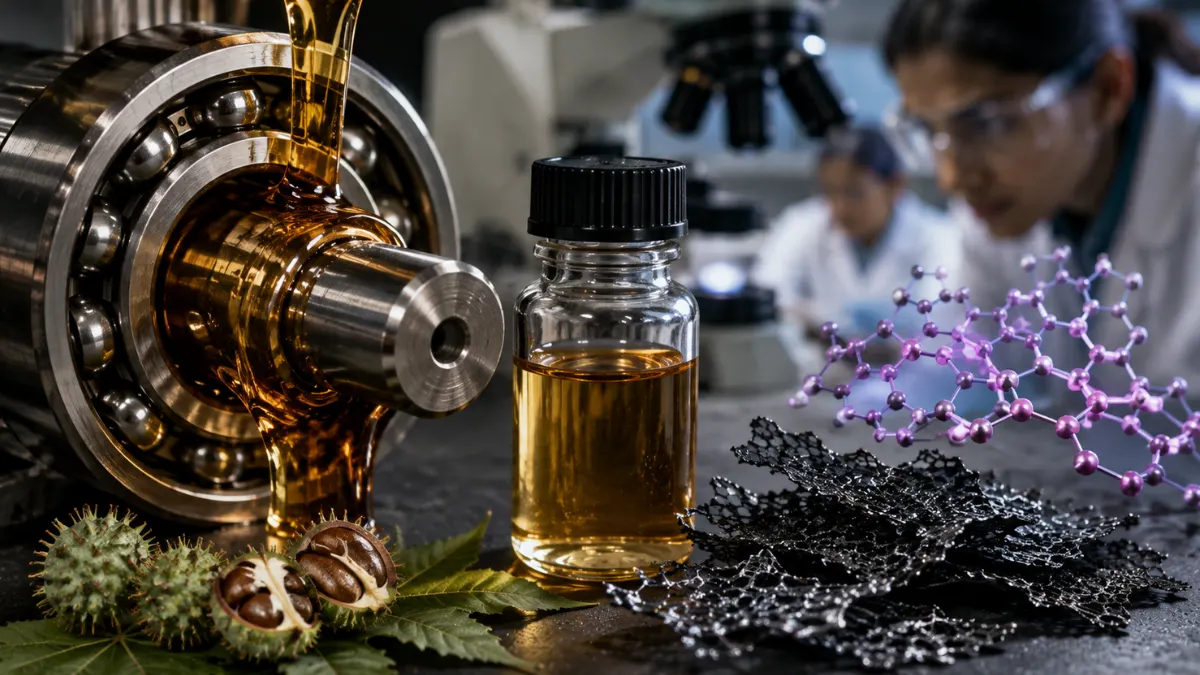

A new borophene-based castor-oil lubricant reduced the average coefficient of friction by about 42% under laboratory test conditions, but researchers from the same Guwahati institute had previously reported a castor-oil nanolubricant with a larger reduction of about 54%. That does not make the newer borophene result less important, because the two percentages come from separate experiments and should not be treated as a direct performance contest.
The more interesting difference is in how the additives work and how they have to be prepared.
In the earlier study, researchers at the Institute of Advanced Study in Science and Technology used graphitic carbon nitride, or g-C₃N₄, nanosheets that needed chemical surface modification before they dispersed effectively in castor oil. The newer borophene study published through the American Chemical Society reports stable dispersion at only 0.1% by weight without surface functionalization, while also producing a chemically active protective film where steel surfaces rub together.
That difference explains why the smaller headline percentage can still represent a scientifically important advance.
Why Can’t the 54% and 42% Results Simply Be Ranked?
The earlier g-C₃N₄ formulation and the newer borophene formulation were not tested as two competitors in one controlled head-to-head experiment.
The earlier IASST research on surface-modified g-C₃N₄ in castor oil used an optimal additive concentration of 0.3 wt%. It reported a 54.23% reduction in average coefficient of friction compared with pure castor oil and a 60.02% reduction in mean wear volume. The tribological assessment used a four-ball tester under defined ASTM-based conditions.
The newer borophene work used an optimal concentration of just 0.1 wt% and reported a decrease in average coefficient of friction from 0.059 for pure castor oil to 0.034, equivalent to roughly 42%.
Those numbers are useful within each study because they compare an additive formulation with the corresponding castor-oil control under the same experimental setup.
They do not establish that g-C₃N₄ is universally a “54% better” lubricant additive while borophene is only “42% better.” Friction measurements depend on factors such as test geometry, load, sliding conditions, materials and formulation. A valid ranking would require both additives to be tested side by side under the same protocol.
The comparison is valuable for a different reason: it shows that the IASST researchers have reached strong friction reductions through two quite different materials strategies.
What Was Different About the Earlier g-C₃N₄ Lubricant?
Graphitic carbon nitride is a two-dimensional material with properties that make it interesting for friction and lubrication research, but the researchers faced a practical problem when trying to mix it into castor oil.
The nanosheets did not naturally have the surface characteristics needed for ideal dispersion in the oily medium.
To improve compatibility, the researchers chemically modified the g-C₃N₄ with octadecyltrichlorosilane, or OTCS. This treatment changed the surface so that the nanosheets became more hydrophobic and dispersed more effectively in castor oil.
That modified formulation performed strongly. At the reported optimum of 0.3 wt%, the average coefficient of friction decreased by 54.23%, while mean wear volume fell by 60.02%. The study also reported increased load-bearing capacity and an improvement in oxidation onset temperature from 320°C to 339°C.
The surface modification was therefore useful rather than an obvious weakness. It solved a compatibility problem and helped produce a high-performing formulation.
However, it also introduced an additional preparation step.
The borophene study becomes interesting precisely because researchers obtained strong dispersion and friction reduction through a different route.
Why Did Borophene Not Need the Same Surface Modification?
Borophene is an atomically thin form of boron with an electron-deficient surface. In the newer experiment, researchers found that this surface interacted favourably with ricinoleic acid, the major fatty-acid component of castor oil.
Those interactions helped keep the borophene nanosheets dispersed without first attaching another chemical layer to their surfaces.
This matters because nanoparticle dispersion is one of the central challenges in developing nanolubricants. If nanosheets attract one another strongly and form large aggregates, they may no longer remain evenly available throughout the oil or behave effectively at the sliding interface.
The borophene formulation avoided that problem at the reported 0.1 wt% loading without requiring the type of functionalization used in the earlier g-C₃N₄ work.
This does not automatically make borophene easier or cheaper to commercialize because producing borophene itself presents separate manufacturing challenges. It does, however, make the lubricant formulation mechanism noteworthy: the nanosheets and castor oil showed useful compatibility without an additional surface-treatment stage.
What Happens When Borophene Reaches the Steel Contact?
The borophene is present throughout the oil, but its most important effects occur in the microscopic region where moving surfaces approach one another.
Even polished steel contains tiny peaks and valleys. During sliding, some of those microscopic high points experience concentrated pressure and friction despite the presence of a lubricant.
Borophene nanosheets entering this region can help alter how the two surfaces interact. Their two-dimensional structure supports relatively easy shearing, but the newer research indicates that the effect goes beyond the physical presence of thin sheets between steel surfaces.
Chemical reactions also occur during rubbing.
Using X-ray photoelectron spectroscopy and time-of-flight secondary ion mass spectrometry, the researchers identified a protective tribofilm containing iron oxides and hydroxides, carbonaceous residues originating from castor oil, and boron-containing species.
The study attributes the improved lubrication to the combination of borophene’s interlayer shearing and its chemical participation in this film. The resulting interface lowers shear stress, supports load carrying and protects the underlying contact surfaces.
This makes borophene different from an additive that merely floats in the oil and physically separates metal.
It becomes involved in creating the surface on which subsequent sliding takes place.
What Did the 42% Result Actually Measure?
At the reported optimum of 0.1 wt% borophene, the average coefficient of friction fell from approximately 0.059 with pure castor oil to 0.034.
The coefficient of friction is a measure of resistance to sliding. The 42% figure therefore describes how much this measured quantity decreased relative to the pure-oil control under the study’s laboratory conditions.
It does not mean a gearbox, turbine, engine or factory would automatically consume 42% less energy after switching to the formulation.
Researchers also measured the surface condition of the steel counterface. Its average roughness, Ra, decreased from about 0.826 micrometres to 0.326 micrometres, while Rq decreased from around 1.01 to 0.405 micrometres.
Those lower values show that the tested steel surface was substantially smoother after the borophene-lubricated experiment, consistent with the protective tribofilm identified through chemical analysis.
They should not be confused with the earlier g-C₃N₄ study’s directly reported 60.02% reduction in mean wear volume, because roughness and wear volume are different measurements.
Keeping those measurements separate prevents a misleading comparison between the two experiments.
So Is the Earlier 54% Additive Actually Better?
The available evidence does not support that conclusion.
A single friction-reduction percentage is only one part of lubricant performance. Researchers also need to consider wear, load carrying, thermal and oxidative stability, dispersion over time, chemical compatibility, additive concentration, manufacturing complexity, toxicity, storage behaviour and long-duration performance.
The earlier g-C₃N₄ system has clear strengths. It reported the larger percentage reduction in average friction, an explicit decrease in wear volume, increased load-bearing capacity and improved thermo-oxidative stability.
The borophene system has a different set of interesting features. It used one-third of the additive concentration by weight reported as optimal in the earlier study, dispersed without chemical surface functionalization, and formed a hybrid boron-containing tribofilm at the rubbing interface.
Neither study was designed to establish which material is the overall winner.
A meaningful comparison would require g-C₃N₄ and borophene formulations to be tested together under identical concentrations, contact geometries, loads, speeds and temperatures, followed by comparable wear and stability measurements.
Until such a study exists, the correct conclusion is that the two approaches demonstrate different ways to improve the tribological performance of castor oil, not that one percentage has defeated the other.
Why Can a Lower Headline Number Still Represent Useful Progress?
Materials engineering rarely comes down to maximizing one number.
An additive that produces the lowest laboratory coefficient of friction might require more material, more complicated processing, expensive synthesis or chemical modification that makes large-scale use difficult. Another material might provide slightly less friction reduction while simplifying formulation or delivering better stability under a different set of conditions.
This is why researchers evaluate an entire performance profile rather than selecting materials from one percentage alone.
The same principle appears in other materials decisions. India’s proposed polymer banknote trial, for example, is not simply about finding a substrate with one superior property. A replacement material has to be assessed for durability, repeated real-world handling, security, production and practical use before broader adoption makes sense.
Lubricants face an even more demanding environment because their performance can change with load, temperature, sliding speed, surface chemistry and operating time.
For borophene, the important advance is therefore not merely that researchers produced a 42% number. It is that a very small amount of an unusual two-dimensional material interacted naturally with a renewable oil, remained dispersed without surface modification and participated in the formation of a protective low-shear interface.
Does Borophene’s Lower Additive Concentration Matter?
It is scientifically interesting, but the concentration should not be used alone to declare borophene superior either.
The borophene formulation reached its reported result at 0.1 wt%, while the earlier surface-modified g-C₃N₄ formulation used an optimal concentration of 0.3 wt%.
A lower loading can be attractive because less additive is required in the final mixture. However, additive concentration is only one part of cost and scalability.
The economics also depend on how difficult and expensive the material itself is to synthesize, purify and produce consistently at large scale.
An inexpensive consistently at large scale.
An inexpensive additive used at 0.3% could ultimately be more practical than an expensive material used at 0.1%. Conversely, eliminating a chemical functionalization step could simplify processing enough to matter in another formulation.
Neither study provides enough evidence to resolve those commercial questions.
For now, the concentration difference tells researchers something useful about how effectively borophene influences the sliding interface at a low loading, not what a future industrial lubricant would cost.
What Would Need to Happen Before Borophene Could Be Used in Real Machines?
The current result is a laboratory demonstration, not an industrial product announcement.
Real lubricants may need to operate for thousands of hours while experiencing changing loads, temperatures, contaminants and sliding conditions. They also have to remain stable during storage and circulation and avoid damaging seals, coatings or other materials in the machine.
Borophene production itself would need consideration as well. A formulation that works with a tiny concentration still requires a dependable way to produce sufficient quantities of consistent nanosheets.
Application-specific testing would then need to determine whether the laboratory friction advantage persists in bearings, gears, marine systems, renewable-energy machinery or other equipment proposed as possible uses.
Long-duration studies would also help determine how stable the protective tribofilm remains and whether the nanosheets maintain suitable dispersion after prolonged operation.
The present research therefore does not show that borophene is ready to replace existing industrial lubricant additives. It demonstrates a new lubrication pathway worth investigating.
The earlier g-C₃N₄ study showed that chemically modifying a two-dimensional material could turn castor oil into a substantially stronger lubricant. The newer borophene work shows that another 2D material can achieve a strong friction reduction at a smaller reported loading without requiring the same surface-functionalization step.
Seen this way, the scientifically important number is not simply 42% or 54%. The larger story is that researchers are learning how the chemistry and structure of nanoscale additives can be matched with a renewable oil so that protection develops exactly where friction occurs.
