
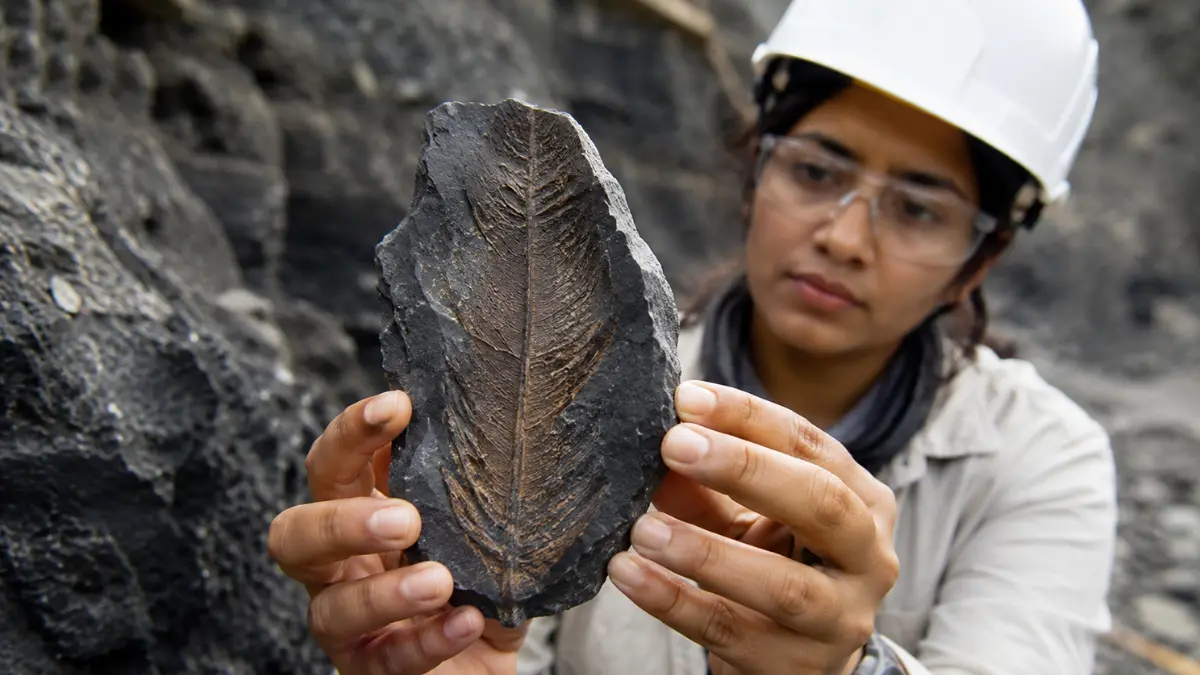

Scientists have identified four fossilised leaves from Assam’s Makum Coalfield that belonged to the ancient screw-pine family about 24 million years ago.
The leaves share several features with plants commonly known today as kewra or kevda, including a long sword-like shape, parallel veins and prickles along the edges. However, the fossils do not prove that the exact modern kewra species grew in Assam at that time.
Researchers classified the fossil leaves as Pandanites trinervis, an extinct fossil-leaf type associated with the Pandanaceae family. The discovery shows that this ancient plant lineage had already become established in the Indian subcontinent during the late Oligocene.
What Did Scientists Find in Assam?
Researchers Harshita Bhatia and Gaurav Srivastava from the Birbal Sahni Institute of Palaeosciences studied four well-preserved fossil leaves collected from the Tikak Parbat Formation of the Makum Coalfield in Assam.
The surrounding rocks date to approximately 24 million years ago. This places the leaves in the late Oligocene, long before humans appeared and millions of years before modern civilisation developed.
The fossils were not complete green leaves trapped inside rock. Over geological time, buried plant material left compressed remains and impressions that preserved parts of the leaves’ shape, veins, surface and edges.
These physical details allowed researchers to compare the fossils with living plants, herbarium specimens and previously documented fossils from other parts of the world.
The study appeared in the scientific journal Geobios under the title “Fossil leaves of Pandanaceae from India suggest Paleogene persistence of the family in South Asia.”
Why Are They Being Called Kewra Fossils?
Kewra, also written as kevda, generally refers to fragrant plants from the genus Pandanus. They belong to the Pandanaceae family, commonly called the screw-pine family.
The name “screw pine” can cause confusion because these plants are not true pine trees. They are tropical flowering plants with long, narrow leaves that often grow in spiral arrangements.
Some living Pandanus plants produce strongly scented flowers used to make kewra water and kewra essence. These products have long been associated with sweets, perfumes and traditional practices in South Asia.
The Assam fossils resemble members of the same broader plant family. Their preserved shape and structure explain why news reports describe them as ancient kewra or kevda leaves.
However, the scientific classification remains more careful.
Researchers assigned the fossils to Pandanites trinervis. Palaeobotanists use the fossil genus Pandanites for leaves that show characteristics of Pandanaceae but cannot be confidently placed within a living genus or species.
Calling them kewra fossils gives readers a familiar comparison, but it should not suggest that scientists recovered the exact ancestor of today’s fragrant kewra plant.
How Did Scientists Identify the Fossil Leaves?
A fossil leaf may appear simple, but its vein pattern, thickness, cross-section and edge structure can contain important identification clues.
The Assam leaves preserved several features associated with the screw-pine family.
They had elongated, narrow blades rather than broad, rounded surfaces. Multiple veins ran parallel along the length of the leaves, while smaller transverse veins crossed between them.
Researchers also observed a distinctive M-shaped transverse section. This means the leaf formed a particular shape when viewed across its width rather than lying completely flat.
The margins contained well-developed prickles. Similar sharp edges occur on many living Pandanus leaves and help separate them from other long-leaved tropical plants.
No single feature would necessarily prove that the fossils belonged to Pandanaceae. The identification became stronger because the leaf shape, vein arrangement, cross-section and marginal prickles appeared together.
The researchers compared this combination with modern botanical specimens, scientific databases and fossil records before assigning the leaves to Pandanites trinervis.
Is the Fossil the Same as the Modern Kewra Plant?
The fossil belongs to the same broader family associated with modern kewra plants, but scientists have not identified it as the exact living kewra species.
This distinction matters because a plant family can contain several genera and hundreds of species. Some members may share similar leaves even when their flowers, fruits, habitats and evolutionary histories differ.
Leaves also preserve only part of a plant’s anatomy. Without clearly connected flowers, fruits, seeds or other diagnostic remains, researchers may not have enough evidence to assign a fossil to a modern species.
The discovery therefore supports a careful conclusion: a pandanaceous plant with kewra-like leaves lived in Assam around 24 million years ago.
It does not prove that modern Pandanus odorifer, the species commonly associated with fragrant kewra products in India, grew in the Makum Coalfield unchanged for that entire period.
The fossils document the persistence of an ancient plant lineage, not the unaltered survival of one modern species.
What Did Assam Look Like 24 Million Years Ago?
The Makum Coalfield did not resemble its present industrial landscape when these plants were alive.
Evidence from the sediments, fossil pollen and leaves indicates that the region contained a warm, humid, lowland environment. Freshwater swamps, riverbank vegetation and evergreen forests covered parts of the landscape.
Water would have moved through channels and wet ground across a tropical delta. Dense vegetation grew around these waterways, producing leaves, wood and other organic material that later became buried in sediment.
Those wet conditions suited ancient members of the screw-pine family. Many living Pandanaceae plants also favour warm tropical environments near wetlands, rivers, forests and coastal areas.
The fossils therefore fit the wider environmental evidence from the Makum deposits. They were not isolated plants growing in an unsuitable landscape. They formed part of a humid tropical ecosystem capable of supporting diverse vegetation.
Modern Northeast India still demonstrates how plants respond to intense rainfall, wetlands and forested terrain. Meghalaya’s living root bridges, for example, depend on the continued growth of rubber fig roots in a humid environment, although they developed millions of years after the Makum fossil forest.
Why Is the Makum Coalfield Important for Fossil Research?
Coalfields often preserve evidence of ancient plant-rich environments.
Coal begins forming when large amounts of dead vegetation accumulate in wet, low-oxygen conditions. Burial can protect part of this organic material from complete decay.
Over millions of years, pressure and geological processes transform the buried vegetation. The same sedimentary layers may preserve leaf impressions, fruits, seeds, wood, pollen and other remains.
The Makum Coalfield has produced a valuable record of Northeast India’s ancient vegetation. Scientists have previously studied fossil leaves, fruits and other plant remains from its late Oligocene deposits.
Each discovery adds another piece to the ecological picture.
One fossil species may reveal the presence of a particular plant family. A larger collection can help researchers reconstruct forest composition, rainfall patterns, temperature and connections between ancient plant communities in different regions.
The kewra-like leaves matter because the fossil record of Pandanaceae remains limited, especially in South Asia. Well-preserved leaves with several diagnostic features are therefore more informative than an uncertain fragment.
Why Does the Discovery Fill a Gap in Plant History?
Scientists have found much older Pandanaceae-related fossils in Europe and North America. Some of those records date to between approximately 85 million and 66 million years ago.
Younger records also appear in tropical parts of Asia and Australia.
The Assam leaves sit between these older northern fossils and later tropical records. They provide evidence that the family persisted in South Asia during the Paleogene, a major period in the development of modern plant and animal groups.
This matters because the global distribution of Pandanaceae changed over time.
Ancient members of the family once occupied a wider geographical range. As the global climate cooled, suitable warm and humid habitats contracted in many regions. The family eventually became concentrated mainly in tropical and subtropical areas.
The Makum fossils suggest that the Indian subcontinent provided suitable conditions where the lineage could continue surviving during this transition.
The discovery does not establish every route through which screw-pine relatives spread across the world. It provides an important geographical and chronological reference point that improves the broader evolutionary record.
Was India a Refuge for Ancient Tropical Plants?
A biological refuge is an area where organisms continue surviving after environmental changes make other regions unsuitable.
The Assam fossils support the view that parts of the Indian subcontinent served as refuges for ancient tropical plant lineages during periods of global climatic change.
As temperatures and habitats changed elsewhere, warm and humid environments in India may have allowed moisture-dependent plants to persist.
This does not mean that the landscape remained completely stable. Rivers shifted, climates changed, mountain systems developed and plant communities evolved over millions of years.
Persistence also does not mean that one species remained unchanged. A lineage can survive while its individual species diversify, disappear or develop new characteristics.
Northeast India’s present biodiversity reflects many interacting forces, including climate, topography, geological history and connections with neighbouring regions. The Makum leaves show that part of this biological richness has roots extending deep into geological time.
Even modern ecological events such as bamboo flowering and rat outbreaks in Mizoram demonstrate how strongly plant life can shape an entire landscape. The fossil record allows scientists to study similar ecological relationships across far longer periods.
Does the Fossil Prove That Kewra Survived Unchanged?
No. The fossils do not prove that modern kewra remained unchanged in India for 24 million years.
News headlines often describe ancient plants as “living survivors.” This phrase can help communicate the age of a lineage, but it can also create the false impression that evolution stopped.
Plant families continue changing over time. New species emerge, populations adapt to local environments and some branches of the evolutionary tree disappear.
The Makum leaves show strong affinity with Pandanaceae. They demonstrate that a plant from this lineage lived in South Asia during the late Oligocene.
They do not establish a direct, uninterrupted line from those individual plants to every modern kewra population.
Scientists would need much more fossil and genetic evidence to reconstruct the exact relationship between Pandanites trinervis and living Pandanus species.
What Can Scientists Learn From One Fossilised Leaf?
A fossil leaf can reveal more than the identity of one plant.
Leaf shape and structure help palaeobotanists identify plant families. Collections of leaves can also indicate whether an ancient forest was tropical, temperate, wet, dry, evergreen or seasonally deciduous.
The sediment surrounding a fossil reveals how the material became buried. Pollen, wood and other fossils found nearby add information about the wider ecosystem.
Researchers can then combine the evidence to reconstruct an ancient environment rather than treating the leaf as an isolated object.
The Makum fossils support the existence of warm, humid, lowland forests with freshwater swamps and river corridors. They also strengthen evidence that tropical plant lineages persisted in India while disappearing from some cooler regions.
Such findings help scientists understand how vegetation responded to earlier climatic changes. They cannot predict the future directly, but they provide long-term records of how plant distributions shift when temperature and rainfall patterns change.

1 thought on “24-Million-Year-Old Kewra Fossil Found in Assam”