
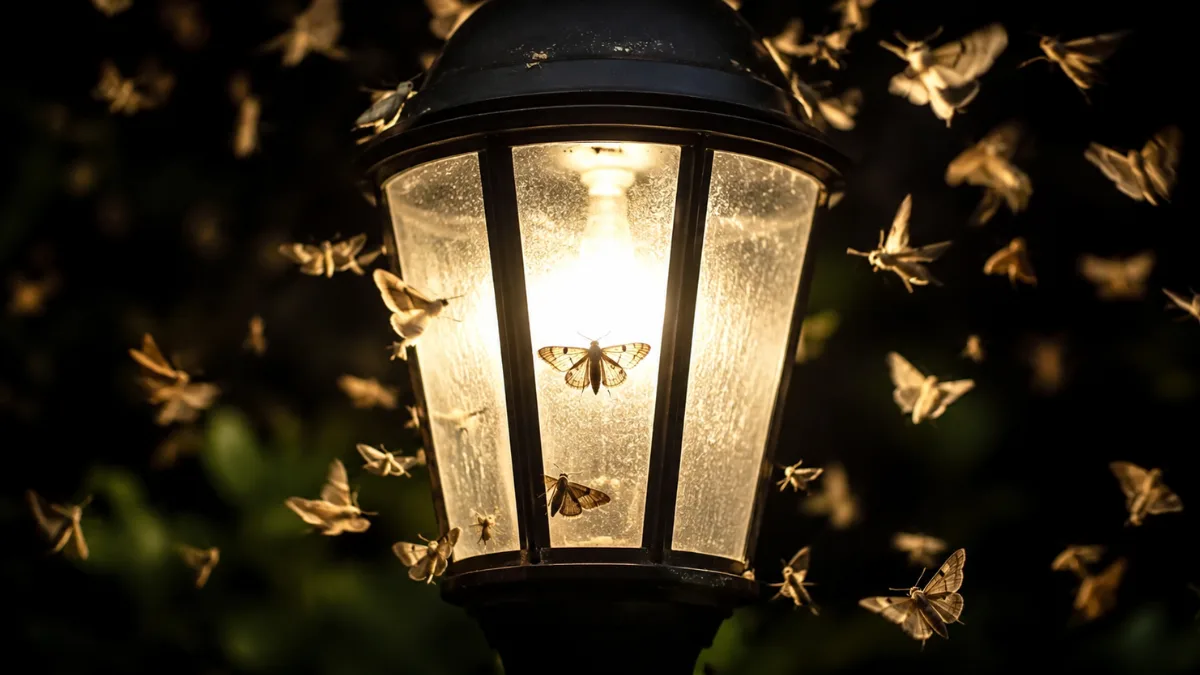

Why do moths fly around lights? At close range, a bright artificial light can confuse the flight-control response that many moths and other insects use to remain upright. Instead of flying directly toward the bulb, affected insects may tilt their backs toward it, forcing them into circles, steep climbs or sudden dives.
This explains why a moth can become trapped around a porch light or streetlamp. However, scientists have not fully established why every moth initially approaches a light from farther away.
The most convincing evidence concerns what happens once an insect enters the area immediately surrounding a bright artificial source.
Why Do Moths Fly Around Lights?
Many flying insects use brightness as one of several cues for determining which direction is up.
In a natural environment, the sky is usually the brightest part of an insect’s surroundings, even at night. The land, vegetation and water below generally appear darker.
Many insects therefore display a behaviour known as the dorsal light response. The word “dorsal” refers to the upper side or back of the body.
This response encourages an insect to keep its back facing the brightest part of its visual environment. Under a natural sky, that simple rule helps it maintain a stable position while flying.
A nearby artificial light disrupts the pattern.
Instead of receiving broad, diffuse light from above, the insect encounters one intense source beside it, beneath it or at another unnatural angle. In many affected insects, the dorsal light response causes the body to tilt toward that source.
Because a flying insect changes direction by tilting its body, this movement can force it to turn continuously around the light.
Researchers described this mechanism in a 2024 Nature Communications study that reconstructed insect flight in three dimensions. Their recordings showed that insects near point sources of light generally did not steer straight toward the bulb. They travelled across the direction of the light while repeatedly tilting the upper sides of their bodies toward it.
The result resembles attraction, but the insect may actually be trapped in a repeated flight-control error.
How Does Artificial Light Confuse a Moth?
A moth must constantly control its body angle, speed and direction while flying.
Gravity can tell the moth which way it is being pulled, but its visual system also needs reliable information about the surrounding environment. A broad region of bright sky provides a useful reference point.
Artificial lights create a visual cue that would rarely exist in nature.
A bulb fixed to a wall may appear as the brightest object beside the moth. A garden lamp may shine upward from below. A strong downward-facing light may illuminate a pale surface so brightly that the reflected glow appears to come from the ground.
When the moth responds to this false reference, it may tilt away from its normal upright position. The forces produced by its wings then push it into a turn, climb or dive.
This is why the behaviour should not be understood as a moth simply seeing a lamp and choosing to circle it.
The moth is responding automatically to brightness in a way that normally supports stable flight. The artificial source turns that useful response into a trap.
Why Do Moths Circle a Bulb Instead of Flying Into It?
Researchers studying insects around artificial lights identified three common abnormal flight patterns: orbiting, stalling and inversion.
Orbiting
Orbiting creates the familiar circular movement seen around porch lights and outdoor bulbs.
As an affected moth tilts its back toward a light beside it, its entire body banks in that direction. Banking changes the direction of the forces generated by the wings, causing the moth to turn.
As the moth moves, the lamp remains beside it. The same response continues, producing a curved or circular path.
The insect may therefore remain near the light without deliberately aiming at the bulb.
Stalling
A moth may also face away from a lamp and begin climbing steeply.
The insect loses forward speed as it climbs. Eventually, it may stall, fall and attempt to regain stable flight.
This can create the irregular rising and dropping movement often seen above an outdoor light.
Inversion
Inversion can occur when an insect flies directly over a bright source.
The insect may roll or pitch its body until its back faces the light below. This can turn it partly or completely upside down and send it diving toward the ground.
Some insects right themselves after falling, climb again and repeat the same movement.
The 2024 flight-tracking study recorded these patterns in insects from several different groups. The researchers rarely observed the same movements when the insects flew in darkness, supporting the conclusion that the point light caused the abnormal flight.
Are Moths Actually Attracted to Light?
Artificial lights clearly cause moths and other insects to gather, but the word “attracted” can hide two separate questions.
The first question is why an insect approaches the general area around a light.
The second is why it circles, stalls or crashes after reaching that area.
The dorsal light response offers strong evidence for the second process. It explains how a point source can trap an insect in unstable flight once the insect is close enough for the light to dominate its visual field.
It does not fully explain how every moth arrives from farther away.
Brightness, wavelength, surrounding darkness, weather, species and the insect’s original flight path may all influence whether it enters the affected area. Scientists continue to investigate the longer-distance flight-to-light response.
For that reason, it would be inaccurate to claim that moths are never attracted to lamps.
A more precise conclusion is that affected moths do not necessarily fly straight toward a nearby light. Once close to it, their normal orientation response can force them into repeated paths that keep them from escaping.
Do Moths Mistake Bulbs for the Moon?
The moon theory has long been used to explain why moths circle artificial lights.
According to this explanation, a moth keeps the moon at a constant angle while travelling. Because the moon is extremely far away, its position changes very little as the moth moves.
A nearby bulb behaves differently. Its angle changes rapidly, supposedly forcing the moth into a spiral.
Some insects can use the moon, stars or patterns of light in the sky for navigation. The wider idea that insects respond to celestial information is therefore scientifically reasonable.
However, the three-dimensional flight recordings did not support the simplest version of the moon-compass explanation for circling near a lamp.
The insects did not consistently maintain the light at a fixed navigation angle. Instead, they repeatedly tilted their backs toward it and often travelled sideways relative to the source.
Computer models based on a corrupted celestial compass also produced a weaker match to the real flight paths than models based on dorsal tilting.
This does not mean that no moth uses the moon during normal travel. It means that mistaking a bulb for the moon is not the strongest explanation for the characteristic orbiting, stalling and diving seen close to artificial lights.
Do Moths Fly Toward Lamps Because of Heat?
Heat is not considered the main reason moths circle artificial lights.
Flames and traditional incandescent bulbs can become hot enough to injure insects that touch them. Heat may therefore influence what happens when an insect reaches the surface of a lamp or flame.
However, insects also gather around cooler light sources.
The abnormal flight begins before the insect touches the source, and researchers have observed it around lights that do not produce the intense heat associated with an open flame.
The phrase “like a moth to a flame” describes the visible result, but it does not accurately explain the moth’s behaviour.
A moth trapped near a flame may eventually cross the hot centre because its flight has become unstable, not because it is deliberately seeking heat.
Why Do Some Lights Affect Moths More Than Others?
Moths do not all respond to light in the same way.
Many nocturnal insects can detect ultraviolet and short-wavelength light particularly well. Sources containing ultraviolet, violet or blue wavelengths may therefore create a strong visual signal for numerous species.
Brightness also matters. An intense exposed bulb can dominate an insect’s visual field more strongly than a dim, shielded source.
The surrounding environment changes the effect as well. A lamp may appear extremely prominent in an otherwise dark garden but become less dominant when other natural or artificial light is present.
Weather can alter the insect’s flight path. The 2024 study found that stable orbiting occurred more often under low-wind conditions, while gusts could disperse insects away from the source.
Species differences remain important. Some moths readily approach artificial lights, while others show weaker or less predictable responses.
Therefore, no single bulb colour or design will affect every nocturnal insect in exactly the same way.
Does Artificial Light Harm Moths?
Circling a lamp and experiencing prolonged night-time illumination are related problems, but they are not identical.
A moth trapped around a point light may waste energy, collide with a surface or become easier for a predator to catch. Remaining near a lamp also takes time away from feeding, finding a mate and other normal night-time activity.
Artificial illumination can produce wider behavioural effects even when a moth is not circling a bulb.
Research published in 2026 examined 843 wild-caught moths from 23 species under different modern LED treatments. Both white and amber artificial lighting substantially reduced normal night-time activity at the tested illumination level. Lower levels of white light also affected some species.
The result does not mean amber light has no value in every setting. It shows that changing colour alone cannot remove the ecological effects of artificial illumination when the light remains bright or operates for long periods.
Reducing unnecessary exposure remains more reliable than replacing one bright bulb with another and assuming the problem has disappeared.
Moths also serve as prey for other animals and pollinate many plants after dark. Disrupting their movements can therefore affect more than the individual insects gathered around a lamp.
India’s insects often depend on specialised environmental signals and life cycles. The World Cup cicada found in Assam and Meghalaya provides another example of how insect behaviour can remain closely connected to local ecological conditions.
How Can Outdoor Lights Disturb Fewer Moths?
Turning off an unnecessary outdoor light is the most direct way to prevent it from disturbing insects.
Where lighting is necessary for safety or movement, the following measures can reduce its reach:
- Use the lowest brightness that serves the actual purpose.
- Shield the bulb so people and insects outside the target area cannot see the exposed source.
- Prevent light from spilling upward, sideways or into nearby plants.
- Use timers or motion sensors instead of leaving lights on throughout the night.
- Close curtains or blinds when bright indoor light faces a garden or open landscape.
- Avoid strongly illuminating pale or reflective surfaces beneath a lamp.
- Limit blue-rich and ultraviolet emissions where practical.
Light direction requires careful attention.
Simply pointing a powerful lamp downward is not always enough. If it creates a bright reflective patch on the ground, the resulting light from below may still interfere with the orientation of flying insects.
A 2024 field study tested specially tailored and shielded road lights that concentrated illumination on the required area while reducing light emitted at wider angles. The redesigned lights attracted significantly fewer flying insects than conventional road lighting at the studied locations.
The practical goal is not complete darkness in every populated area. It is to use light deliberately rather than allowing it to spread far beyond the place and time in which people need it.
Why Does the Moth Keep Returning After Flying Away?
A moth may briefly escape the strongest part of a lamp’s influence and then enter it again.
The surrounding light can continue to affect its direction, particularly if the moth remains close enough for the artificial source to dominate the natural sky.
The insect may correct its position after a stall or dive, only to repeat the same dorsal tilting response when it climbs back toward the lamp.
This creates the impression that the moth is repeatedly choosing to return.
In reality, the returning path may form part of the same orientation problem. Until the moth moves far enough away or another cue becomes stronger, it can remain caught in a cycle of correction and renewed disruption.
What Do Scientists Know With Confidence?
Scientists now have strong evidence that a nearby point source of artificial light can disrupt flight by causing many insects to tilt their backs toward it.
That response can generate the familiar orbiting, stalling and inversion seen around lamps.
The research also shows that affected insects do not always fly directly toward the source once they are close to it. Their curved flight can trap them near the lamp instead.
Questions remain about how different species respond, how far away artificial lights influence insects and why an individual moth initially approaches a particular source.
The most accurate answer therefore avoids both extremes.
Moths are not simply fascinated by bulbs, but science has not proved that every approach to light has one universal cause. What the evidence shows most clearly is that a nearby lamp can corrupt a natural system used for stable flight, leaving the moth circling a light it may no longer be able to escape.

2 thoughts on “Why Do Moths Fly Around Lights? How Lamps Trap Their Flight”