
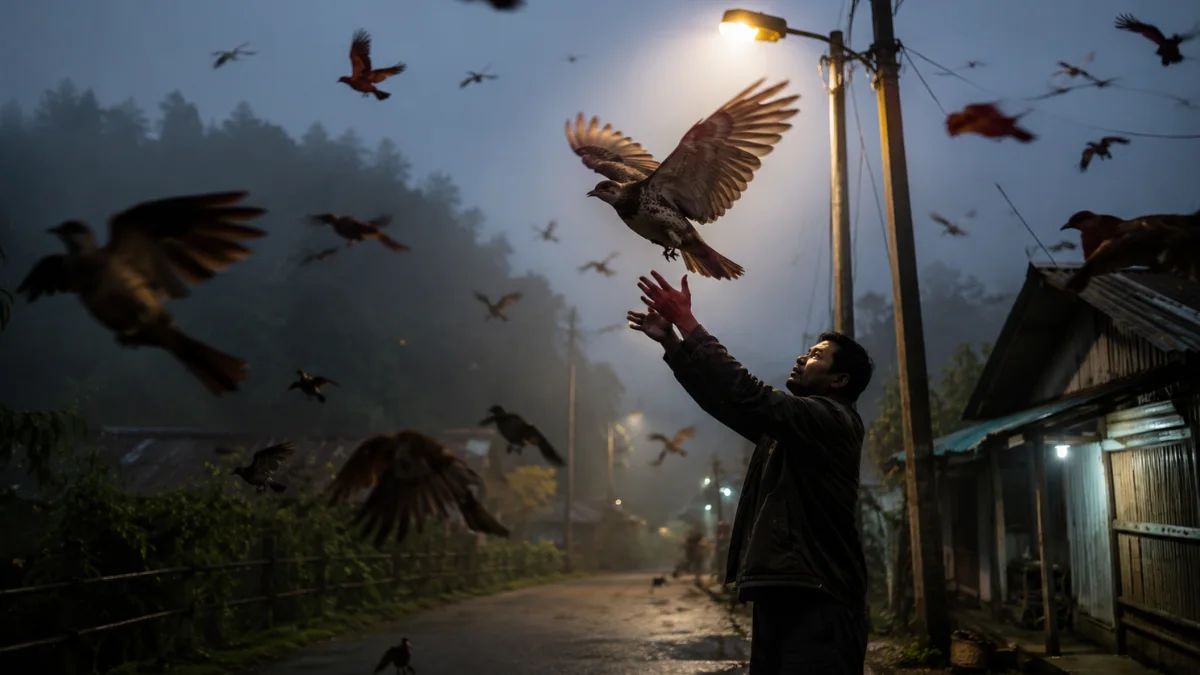

Birds in Jatinga do not deliberately fall from the sky or commit suicide. On certain dark, foggy and windy nights, mainly local or short-distance-moving birds become disoriented and fly toward artificial lights in this hill village of Assam.
Some birds collide with trees, buildings or other objects. Others descend close to the ground in a confused or exhausted condition. Historically, many deaths occurred after people captured or killed the affected birds.
This unusual event gave Jatinga its reputation as India’s “bird-suicide village.” However, the strongest available explanation involves weather, terrain, bird movement and artificial lighting acting together.
What Actually Happens to Birds in Jatinga?
Jatinga is a small hill village near Haflong in Assam’s Dima Hasao district. It lies along a ridge connected to the Barail Range and is surrounded by forests, valleys and bird habitats.
The phenomenon is mainly associated with the period from August to November, with many historical observations concentrated in September and October.
It does not occur every night or throughout the entire season. A particular combination of darkness, fog, drizzle, strong winds and artificial lighting usually needs to develop.
Under these conditions, some birds appear near lamps and illuminated areas in the village. They may fly unusually low, lose control, strike nearby structures or land on the ground.
The birds do not simply die in the air and fall from the sky. Many remain alive when they reach the village, although they may be exhausted, injured or temporarily disoriented.
Do Birds Really Commit Suicide in Jatinga?
No evidence shows that birds intentionally kill themselves in Jatinga.
The word “suicide” suggests that the birds understand death and deliberately fly toward it. Their behaviour instead shows confusion, disrupted navigation and attraction toward visible light during difficult weather.
The popular label developed because people saw birds descending near lights and later found dead or injured birds. Over time, dramatic stories turned a complex ecological event into a mystery about birds choosing death.
A more accurate description would be the Jatinga bird-disorientation phenomenon.
The birds do not travel to Jatinga for the purpose of dying. A rare set of environmental conditions appears to disturb their movement and draw them toward lights positioned along the ridge.
Why Do Weather Conditions Disorient the Birds?
The Jatinga phenomenon does not have one simple cause. Several environmental conditions appear to interact.
Strong winds disturb resting or moving birds
Powerful winds may disturb birds resting in nearby forests or push moving birds away from their normal routes.
Smaller birds, young birds and species travelling between nearby habitats may find it difficult to control their direction during strong winds. Once displaced, they may enter unfamiliar parts of the ridge.
A bird that normally travels safely between a forest, wetland or feeding area may suddenly face air currents that push it toward the village.
Fog and drizzle reduce visibility
Dense fog and drizzle make it harder for birds to see the surrounding landscape.
Under clear conditions, birds can respond to visible trees, slopes, valleys and open flight paths. During heavy mist, those features become difficult to detect.
A bird pushed by wind may therefore struggle to identify a safe direction or suitable place to land.
Moonless darkness makes navigation harder
Many observations have occurred during dark or moonless nights.
Darkness alone does not create the phenomenon. However, when darkness combines with fog, rain and powerful wind, a disturbed bird may have very few visible clues to guide its movement.
An artificial light can then become the most noticeable point in an otherwise dark landscape.
How Does Jatinga’s Landscape Affect the Birds?
Jatinga’s position along a narrow ridge may help explain why the event repeatedly occurs in the same place.
The surrounding hills and valleys can channel strong winds through particular passages. This may create a funnel-like effect that pushes displaced birds toward the ridge instead of allowing them to spread across the wider landscape.
The village also lies close to forests, wetlands and valleys used by different bird species. Birds moving between these habitats may cross the ridge during local or seasonal journeys.
When powerful winds, fog and darkness appear together, the landscape may guide some of those birds toward the populated area.
This combination makes Jatinga different from an ordinary village experiencing bad weather. Its ridge position, nearby bird habitats and concentrated lights create an unusual setting in which bird disorientation becomes more visible.
Why Do Artificial Lights Attract the Birds?
Artificial lighting plays an important role after the birds become disoriented.
A bird moving through fog and darkness may see a lamp as the clearest visible point in the landscape. It may approach the light while searching for shelter, direction or a place to land.
Strong directional lights can become especially noticeable when clouds, mist and surrounding darkness hide almost everything else.
Once a bird flies close to the light, it may circle the area, lose altitude or collide with a building, pole, tree or other object.
The light does not necessarily cause the entire event by itself. The bird may already be struggling because of wind, fog and disrupted movement before it notices the light.
Artificial lighting therefore forms part of a larger chain of conditions rather than acting as the only cause.
Are the Birds Long-Distance Migrants?
The affected birds are not all international or long-distance migrants.
Records include resident birds and species making local or seasonal movements through the forests, valleys and wetlands of the Barail landscape.
Young and sub-adult birds also appear frequently in historical observations. Less experienced birds may find it harder to respond to unfamiliar terrain, severe weather and concentrated lighting.
Some species may move short distances between feeding, resting or breeding habitats. These journeys still represent local or seasonal movement, but they do not mean the birds have travelled from distant countries.
Describing every affected bird as a foreign migratory bird creates another misleading part of the Jatinga story.
Which Birds Become Affected?
The phenomenon does not affect every bird living near Jatinga.
Historical records have included several groups:
- Herons and egrets
- Bitterns
- Kingfishers
- Pittas
- Doves and pigeons
- Other forest and wetland birds
A limited number of species appear more frequently than others.
The affected birds also differ in age, habitat and movement patterns. This suggests that vulnerability depends on several factors, including body size, flight behaviour, experience and response to difficult weather.
The selective nature of the event also shows that Jatinga does not cause every bird in the area to lose control.
Why Did So Many Birds Die Historically?
Weather and collisions did not cause every recorded death.
Villagers historically learned that confused birds approached lamps and torches on certain nights. The birds flew slowly, descended close to the ground or landed nearby, making them easy to capture.
People collected some of these birds for food. This practice turned a temporary disorientation event into a fatal one for birds that might otherwise have rested and recovered.
Reports of dead birds later strengthened the belief that the animals had intentionally flown toward death.
The phrase “bird suicide” therefore hides an important fact: many birds did not die before reaching the village. Human capture contributed significantly to the historical death toll.
Conservation campaigns later encouraged residents to stop killing the birds and protect those that became disoriented.
Is the Jatinga Mystery Completely Solved?
Researchers have developed a strong environmental explanation, but they have not reduced the phenomenon to one single cause.
The available evidence points to several conditions acting together:
- Strong winds
- Fog and drizzle
- Dark or moonless nights
- Ridge topography
- Local or seasonal bird movement
- Attraction toward artificial lights
- The age and behaviour of individual birds
The importance of each factor may change between nights, species and individual birds.
A young forest bird disturbed by wind may react differently from an adult wetland bird making a seasonal movement. Some birds may collide with objects, while others may simply land and recover.
This remaining uncertainty does not support supernatural explanations. It shows that wildlife behaviour often results from several environmental pressures rather than one simple trigger.
Does the Jatinga Phenomenon Happen Every Year?
The phenomenon is associated with the late monsoon and post-monsoon period, mainly between August and November.
However, the number of affected birds and the intensity of the event can change from year to year.
Weather conditions may not align in the same way every season. Changes in forest cover, bird populations, village lighting and conservation practices may also influence what people observe.
The event does not happen on a fixed date, and thousands of birds do not fall every night.
Jatinga became famous because similar conditions produced repeated observations over many years, not because the phenomenon follows an exact annual schedule.
How Are Birds Protected Today?
Greater awareness has changed the way local communities and visitors understand the event.
Instead of treating affected birds as supernatural signs or easy targets, conservation efforts encourage people to rescue, protect and release them.
Useful protection measures include:
- Preventing hunting and capture
- Reducing unnecessarily bright lights during high-risk nights
- Rescuing injured or exhausted birds
- Keeping crowds away from disoriented birds
- Protecting nearby forests and roosting areas
- Recording weather and bird activity
- Educating visitors about the scientific explanation
Carefully directed lighting may reduce the chance of drawing confused birds toward buildings and roads.
Long-term monitoring can also help researchers understand how changes in weather, habitat and human development affect the phenomenon.
Why Jatinga Matters Beyond the Mystery
Jatinga shows how wildlife behaviour can change when weather, geography and human activity meet in one place.
Strong winds and poor visibility may first disturb the birds. The narrow ridge may influence their direction, while artificial lights can draw them toward the village.
Jatinga is also part of a wider pattern of unusual ecological events found across Northeast India. In Mizoram, mass bamboo flowering can lead to rat outbreaks because the temporary abundance of bamboo seeds supports rapid growth in rodent populations.
Assam also experiences a remarkable four-year World Cup cicada cycle, during which large numbers of cicadas emerge in years that coincide with the FIFA World Cup.
These events have different causes, but each shows how local landscapes, biological cycles and animal behaviour can create extraordinary natural phenomena across Northeast India.
They deserve careful scientific explanation rather than exaggerated stories.
What Really Causes the Jatinga Bird Phenomenon?
Birds in Jatinga do not deliberately choose death.
The strongest explanation suggests that powerful winds disturb birds in nearby forests and valleys. Fog, drizzle and darkness make navigation harder, while the shape of the ridge may channel them toward the village.
Artificial lights then become highly visible and attract some of the confused birds. They may fly low, collide with objects or land near homes and roads.
Historical hunting caused many deaths after the birds reached the village.
Jatinga remains an unusual ecological event, but it is not evidence of mass bird suicide. It shows how weather, terrain, wildlife movement and artificial light can combine to disrupt bird behaviour.

2 thoughts on “The Real Reason Birds Descend in Jatinga, Assam”