
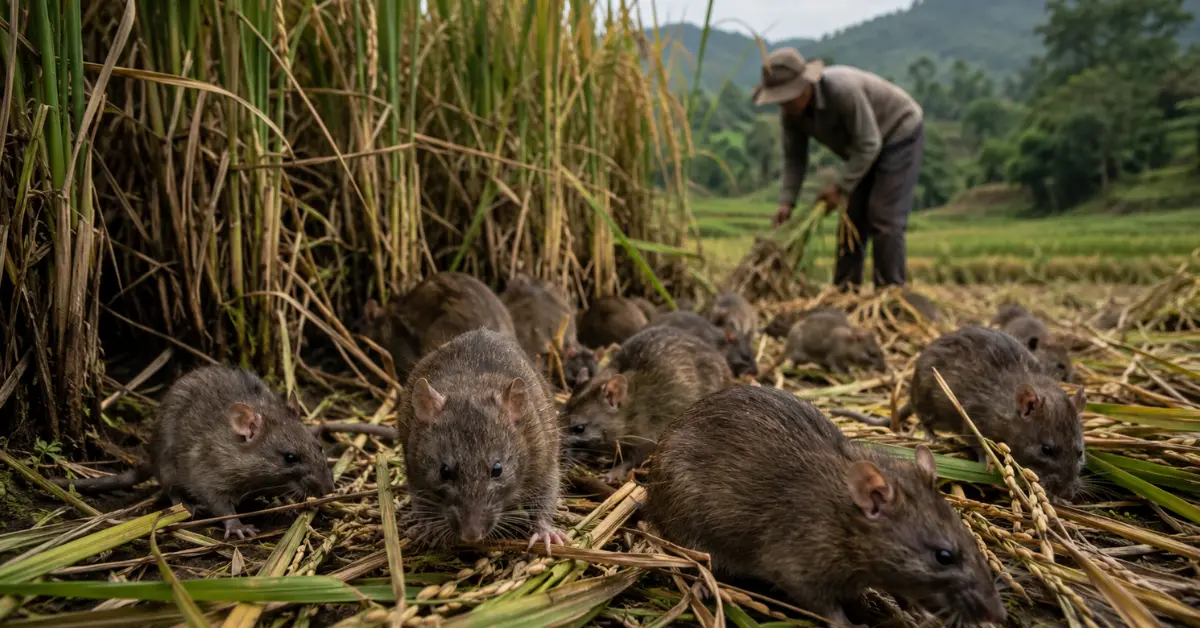

Bamboo flowering is driving rats into farms across Mizoram because the plants produce a temporary abundance of seeds. Rodents feed on those seeds, survive in greater numbers and reproduce while food remains plentiful. When the supply inside the bamboo forests begins to fall, the enlarged rodent population moves toward rice fields, vegetable farms and grain stores.
This chain of events has turned a rare natural cycle into a serious agricultural problem. Farmers may notice the damage only when rats enter their fields, but the process begins months earlier in the surrounding forests.
Also Read: Rare Black Panther Family Seen in Assam’s Manas
What Is Happening in Mizoram?
Mizoram is experiencing a mass-flowering cycle involving Bambusa tulda, a bamboo species locally known as rawthing. People in the state call the phenomenon Thingtam.
This bamboo does not flower every year. Large numbers of plants can grow for several decades before flowering across a wide area around the same period. After flowering, the bamboo produces seeds and eventually begins to dry.
The seeds create an unusually large food supply for rodents living around the forest. Their numbers rise, and the problem gradually spreads beyond the bamboo-covered hills.
By July 2026, reports citing estimates from Mizoram’s Agriculture Department said the outbreak had affected more than 5,300 farmers. Rice suffered some of the most serious losses, although rats also damaged maize, ginger, pumpkin, beans and other crops.
The situation has become especially difficult in farming communities located close to bamboo forests. Families that depend on a small number of fields can lose both their expected income and the grain they planned to store for the year.
How Bamboo Flowering Leads to a Rat Surge
The flowers themselves do not directly push rats into farms. The important connection involves the seeds that appear after flowering.
The ecological sequence usually develops in four stages.
Bamboo produces a sudden supply of food
During mass flowering, thousands of bamboo plants can produce seeds across a large landscape. These seeds become easily available to rodents living on the forest floor.
Food normally limits the number of rats that an area can support. When that limit temporarily disappears, more adult rodents remain healthy and more young rodents survive.
Rodents reproduce while food remains abundant
Rats reproduce quickly when conditions support them. A steady supply of bamboo seeds allows the population to grow over several breeding cycles.
The increase does not happen instantly. Farmers may not notice anything unusual during the early flowering stage because much of the activity remains inside or close to the bamboo forest.
Researchers also caution that flowering alone does not determine the exact size of every outbreak. Rainfall, flowering time, habitat conditions and the availability of other food can influence how rapidly rodent numbers increase.
However, mass seeding creates the abundance that makes a major population surge possible.
The bamboo seed supply begins to decline
The temporary food boom cannot continue indefinitely. Rodents consume the fallen seeds, while the flowering bamboo completes its life cycle.
At this point, the landscape may contain far more rats than it could support before the flowering began. The population remains large even as the original food source starts disappearing.
Rats move toward farms and stored grain
The rodents then search for other concentrated sources of food. Ripening rice, maize, vegetables and stored grain become obvious targets.
This movement creates the impression that rats have suddenly appeared in villages. In reality, their numbers grew gradually before food pressure pushed them beyond the forest.
Also Read: India’s World Cup Cicada and Its Four-Year Life Cycle
Why the Current Event Is Called Thingtam
People sometimes describe every bamboo-related rodent outbreak in Mizoram as Mautam. However, Thingtam and Mautam refer to different bamboo-flowering cycles.
Thingtam primarily involves Bambusa tulda. Mizoram’s disaster-management records state that it occurs approximately every 47 to 48 years. Earlier recorded periods occurred around 1881, 1928 and 1976.
Mautam primarily involves Melocanna baccifera, another common bamboo species in the region. It follows its own long flowering cycle and has also caused major rodent outbreaks in the past.
Both events can follow a similar ecological pattern:
Bamboo flowers, seeds become abundant, rodent numbers rise, the seeds decline and rats move toward human food sources.
The similar outcome explains why the two names often become mixed together. Still, identifying the present outbreak as Thingtam gives readers a more accurate understanding of the bamboo species and cycle involved.
Why Rice Fields Face the Greatest Risk
Rice fields provide a large and concentrated supply of food at the time rats begin leaving the bamboo forests.
A paddy field also offers cover. Rodents can move through dense plants, feed after dark and remain difficult to detect until the damage becomes widespread.
They may eat developing grains, cut rice stalks or carry harvested grain away from storage areas. Damage shortly before harvest can erase months of work within a few nights.
Farmers often try to protect their fields by staying awake at night, checking traps and making noise to scare the animals away. These efforts may help against a small infestation, but they struggle to stop a rodent movement affecting several villages at the same time.
The loss has consequences beyond the field. A household that expected to store rice for several months may need to buy grain instead. Families may also lose crops that they intended to sell for cash.
This combination of food loss and reduced income explains why bamboo-related rodent outbreaks can create serious food-security concerns even when commercial supplies remain available.
Why Farmers Cannot Solve the Problem Field by Field
Ordinary rat control usually focuses on one building, grain store or farm. Thingtam creates a landscape-level outbreak.
A farmer may remove rats from one plot, but more can continue arriving from nearby forests, slopes and abandoned land. Fields also share boundaries, paths and water channels that allow rodents to move between them.
Individual action therefore has limited value unless neighbouring farms and villages respond at the same time.
Authorities have distributed rodenticides in affected areas and conducted awareness programmes on their use. Many farmers also rely on traditional bamboo traps placed along field edges and rodent paths.
Each method has limitations.
Traps require regular checking and may capture only a small portion of the population. Chemical control can cover a wider area, but farmers must handle and place poison carefully to reduce risks to people, livestock, wildlife and water sources.
A successful response needs coordination rather than one temporary campaign. Agriculture teams must identify the worst-affected locations, monitor rodent movement and help communities apply control measures safely across connected areas.
Why Waiting Until Rats Reach the Fields Is Too Late
The visible agricultural crisis begins after the rodent population has already expanded.
Once large numbers of rats enter ripening fields, farmers have little time to protect the harvest. Emergency action may reduce further losses, but it cannot restore crops that rodents have already destroyed.
Earlier monitoring offers a better approach.
Officials and local communities can record where bamboo starts flowering, when seeds appear and where rodent activity begins increasing. That information can help predict which farming areas face the highest risk.
Preparation may include:
- supplying traps and safe pest-control materials before crop damage peaks;
- strengthening household and community grain stores;
- clearing places where rats can hide near storage areas;
- coordinating control work between neighbouring villages;
- preparing seed assistance for farmers who lose their harvest;
- monitoring rodent numbers rather than relying only on damage reports.
These measures cannot stop bamboo from flowering, but they can reduce the delay between the first ecological warning and the agricultural response.
Why Grain Storage Matters as Much as Field Protection
Protecting standing crops receives the most attention, but stored food can remain vulnerable after harvest.
Rats can enter weak storage structures, damage sacks and contaminate grain. A farmer who successfully harvests rice may still lose part of it unless the household stores it securely.
Rodent-resistant containers, raised storage platforms and well-maintained community granaries can limit these losses. Villages also need to remove spilled grain and food waste that attract rats around homes.
Storage protection becomes especially important during a prolonged outbreak. Rodent pressure may continue after the main crop season because the enlarged population still needs food.
A response that ends immediately after harvest could therefore leave families exposed during the following months.
Also Read: Why Mosquitoes Bite Some People More Than Others
What Thingtam Reveals About Natural Cycles
Thingtam does not represent a random invasion of rats. It shows how a predictable change in one part of an ecosystem can affect forests, wildlife, farms and household food supplies.
The bamboo creates a temporary food boom. Rodents respond to that abundance. Their population eventually becomes too large for the declining forest food supply, so they move into human-managed landscapes.
Farmers experience the final stage of a process that began long before the first rice stalk was damaged.
Mizoram cannot prevent this biological cycle, but it does not have to treat every return as a complete surprise. Historical records and flowering observations provide advance warning. The remaining challenge involves turning that knowledge into early monitoring, coordinated pest control, secure food storage and timely assistance for affected farmers.
Understanding why bamboo flowering drives rats into farms is the first step. Acting before the seed supply disappears will determine how much damage the next stage causes.

3 thoughts on “How Bamboo Flowering Leads to Rat Outbreaks in Mizoram”