
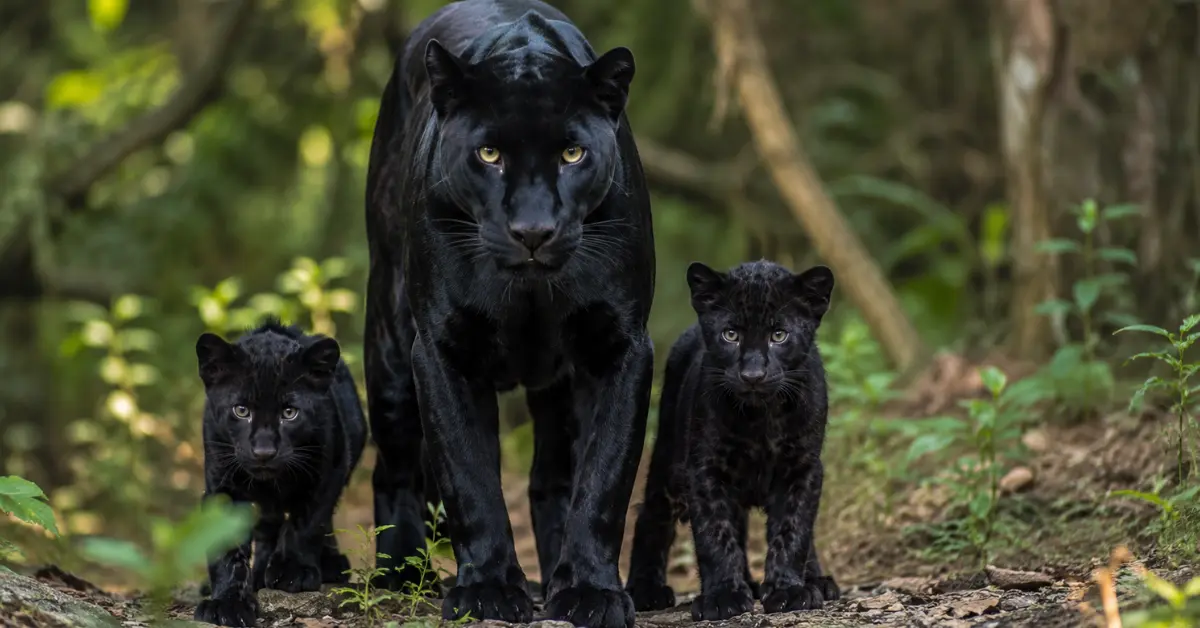

A rare black panther in Assam’s Manas National Park avoided cameras for five years before wildlife photographer Debashis Banerjee finally photographed her with two cubs. The sighting confirmed that the elusive animal still lived inside the protected forest and revealed that she had successfully raised a new generation.
The photographs attracted attention far beyond Assam because melanistic leopards remain extremely difficult to observe in the wild. Their dark coats blend into shaded forests, while their naturally secretive behaviour allows them to move through large areas without approaching roads, tourists or camera traps.
However, the black panther’s unusual appearance represents only one part of the story. Her return with two cubs also highlights the importance of undisturbed habitat, careful wildlife monitoring and responsible tourism in Manas National Park.
What Happened in Assam’s Manas National Park?
Wildlife photographer Debashis Banerjee photographed a female melanistic leopard moving through Manas National Park with two cubs. Reports described the female as an animal that had avoided cameras for five consecutive years despite signs that suggested she still occupied the forest.
Her footprints and faint movement trails reportedly kept the mystery alive, but researchers and photographers lacked clear visual confirmation. The new photographs finally provided that evidence.
The presence of the cubs made the sighting even more significant. Instead of documenting one rare animal, the images showed a breeding female caring for young inside the Manas landscape.
Other black-panther sightings had already generated interest in the park during 2026. Reports from May described three melanistic leopards moving together in the southern part of Manas near the Bhutan border. Public reports have not clearly established whether those animals belonged to the same family photographed later.
Researchers would need repeated camera-trap images, visible coat patterns and movement records to determine whether different reports show the same leopards or separate individuals.
Also Read: Assam’s World Cup Cicada and Its Four-Year Life Cycle
What Is a Black Panther?
A black panther does not belong to a separate animal species.
In Assam and other parts of Asia, people generally use the name “black panther” for a melanistic leopard. The animal belongs to the same species as an ordinary golden-yellow leopard, but a genetic variation causes its body to produce much more dark pigment.
This increased pigmentation gives the fur a black or very dark brown appearance. The colour can make the animal look completely different from a normally coloured leopard, especially when it moves through a dim forest.
The colour change does not transform its body structure, behaviour or species identity. A black panther still hunts, climbs, marks territory and raises cubs like other leopards.
People also use the term “black panther” for melanistic jaguars in Central and South America. Assam does not have wild jaguars, so a black panther seen in an Assam forest refers to a melanistic leopard.
Does a Black Panther Still Have Spots?
A melanistic leopard still carries the familiar rosette-shaped markings seen on other leopards.
Dark pigment covers both the background colour and the markings, making the pattern difficult to notice from a distance. Sunlight, side lighting or a close photograph can reveal the rosettes beneath the dark coat.
This hidden pattern helps photographers and wildlife researchers identify individual black leopards. Every leopard carries a slightly different arrangement of rosettes, much like every person carries unique fingerprints.
Clear photographs can therefore help researchers compare sightings and determine whether cameras recorded the same animal at different locations.
The coat may look uniformly black during a quick sighting, especially under thick vegetation. That appearance explains why many people mistake the animal for a completely different big cat.
Also Read: How to Reduce Indoor Heat During El Niño Conditions
How Did the Leopard Avoid Cameras for Five Years?
The female did not need to understand camera traps to avoid them. Her natural behaviour and the size of the Manas landscape gave her many opportunities to remain undetected.
Leopards move quietly and often stay active during periods when human activity falls. They use thick vegetation, riverbanks, slopes and animal trails to travel without exposing themselves in open areas.
Camera traps also monitor only selected points inside a forest. Researchers usually place them along paths where animals appear likely to walk. A leopard can avoid those paths, move behind the camera or pass through an area outside the monitoring period.
Manas contains forests, grasslands, rivers and areas of dense cover along the Himalayan foothills. The park also connects with forest habitats across the Bhutan border. This large and varied landscape gives wildlife enough space to move beyond roads and frequently monitored locations.
The leopard’s dark coat may make visual detection even harder. Deep shadows, wet vegetation and low forest light can conceal most of her body, even when she stands relatively close to an observer.
A photographer may see only a brief dark movement before the animal disappears into vegetation. At night, poor lighting can prevent a camera from recording enough detail to confirm the animal’s identity.
Why Do the Two Cubs Matter?
The two cubs show that the female survived long enough to mate, give birth and care for her young inside or near the Manas landscape.
A female leopard needs suitable cover to hide her cubs during their most vulnerable stage. She also needs dependable prey and enough space to hunt without facing constant disturbance.
The sighting therefore provides an encouraging sign that at least part of Manas continues to support leopard reproduction. However, one photograph cannot prove that the overall leopard population has increased or that every part of the ecosystem remains healthy.
Researchers need long-term monitoring to understand population trends. They must identify individual leopards, record breeding activity, estimate survival rates and study how the animals use different parts of the park.
The cubs also raise questions that future observations may answer. Researchers may learn whether either cub inherited the dark coat, how long the family remains together and where the young animals travel after becoming independent.
The mother will care for the cubs until they develop the skills to hunt and survive alone. After separation, each young leopard may search for its own territory within Manas or the surrounding connected forests.
Will the Cubs Also Become Black Panthers?
A black mother does not guarantee that every cub will display the same dark coat.
The cubs inherit genetic material from both parents, and the unknown father also influences their coat colour. Depending on the genetic combination, a melanistic female may produce dark cubs, normally coloured cubs or a mixed litter.
Clear photographs would provide the simplest early evidence of their colour. However, shade, distance and image quality can make young cubs difficult to assess accurately.
Normally coloured cubs may still carry a genetic variant linked to melanism without showing the black appearance themselves. Those animals may later pass the variant to another generation.
Wildlife researchers should avoid making conclusions from unclear images. Repeated sightings will provide a better understanding of the cubs’ appearance and development.
What Does the Sighting Reveal About Manas?
The photographs confirm that a breeding melanistic leopard uses the Manas landscape. They also show why large, connected habitats matter for secretive predators.
Manas National Park protects a rich mixture of forests and grasslands in western Assam. The protected landscape extends toward Bhutan’s Royal Manas National Park, allowing animals to move across a much wider ecological area than a single park boundary might suggest.
Leopards need access to prey, water, cover and secure breeding spaces. When forests become fragmented by roads, settlement or heavy disturbance, females may struggle to find safe places for their cubs.
The family’s presence suggests that the area still provides some of those essential conditions. It does not remove the need for continued protection.
Poaching, habitat pressure, uncontrolled tourism and conflict near forest boundaries can still threaten large predators. Conservation teams must continue monitoring wildlife movements and protecting important corridors between habitats.
The value of Manas also extends beyond rare coat colours. The park supports many animals that depend on its forests, grasslands and rivers. The black leopard draws attention, but protecting the entire habitat protects every species that shares it.
Why the Sighting Does Not Prove a Black-Panther Population Boom
Several sightings within a short period can create the impression that black panthers have suddenly multiplied across Manas.
The available evidence does not yet support that conclusion.
Different photographers may record the same individuals at different times. A mother travelling with two cubs can also create multiple sightings without representing three unrelated adult animals.
Seasonal changes may make wildlife easier to observe along certain routes. More tourists, photographers and cameras can also increase the number of records even when the actual population remains unchanged.
Researchers must compare body size, sex, rosette patterns, locations and movement dates before estimating the number of melanistic leopards in the park.
Responsible reporting should therefore describe the sighting as rare and encouraging without claiming that Assam now has a rapidly growing black-panther population.
Why Responsible Tourism Matters After the Sighting
Rare wildlife photographs often attract visitors who hope to see the same animal. This attention can support local tourism and strengthen public interest in conservation, but it can also place pressure on the animals.
A mother with cubs needs space. Vehicles that crowd around a sighting, people who make noise or photographers who chase the family can interrupt feeding, movement and resting behaviour.
Visitors should follow safari routes, obey forest staff and maintain a safe distance. They should never pressure guides to leave approved tracks or approach a suspected den site.
Tourists also need realistic expectations. A black-panther sighting remains extremely rare, and a visit to Manas cannot guarantee one. The female avoided cameras for years precisely because she lives as a secretive wild predator.
Responsible wildlife tourism values the forest experience even when the most famous animal never appears.
Why This Assam Sighting Deserves Attention
The photograph of a black leopard with two cubs offers a rare view into a life that continued beyond human observation for years.
The female did not disappear simply because cameras stopped recording her. She continued moving through Manas, found a mate and raised two cubs while remaining almost invisible to researchers, tourists and photographers.
Her story demonstrates both the limits of wildlife monitoring and the value of protected habitat. Cameras can help people study animals, but forests must still give those animals enough space to avoid people.
The sighting deserves celebration, but conservation should remain the priority. Careful monitoring may eventually reveal more about the mother, her cubs and the number of melanistic leopards living in Manas.
Until then, the photographs provide one clear conclusion: Assam’s forests still hold wildlife that can surprise people even after years of searching.

1 thought on “Rare Black Panther Family Seen in Assam’s Manas”