
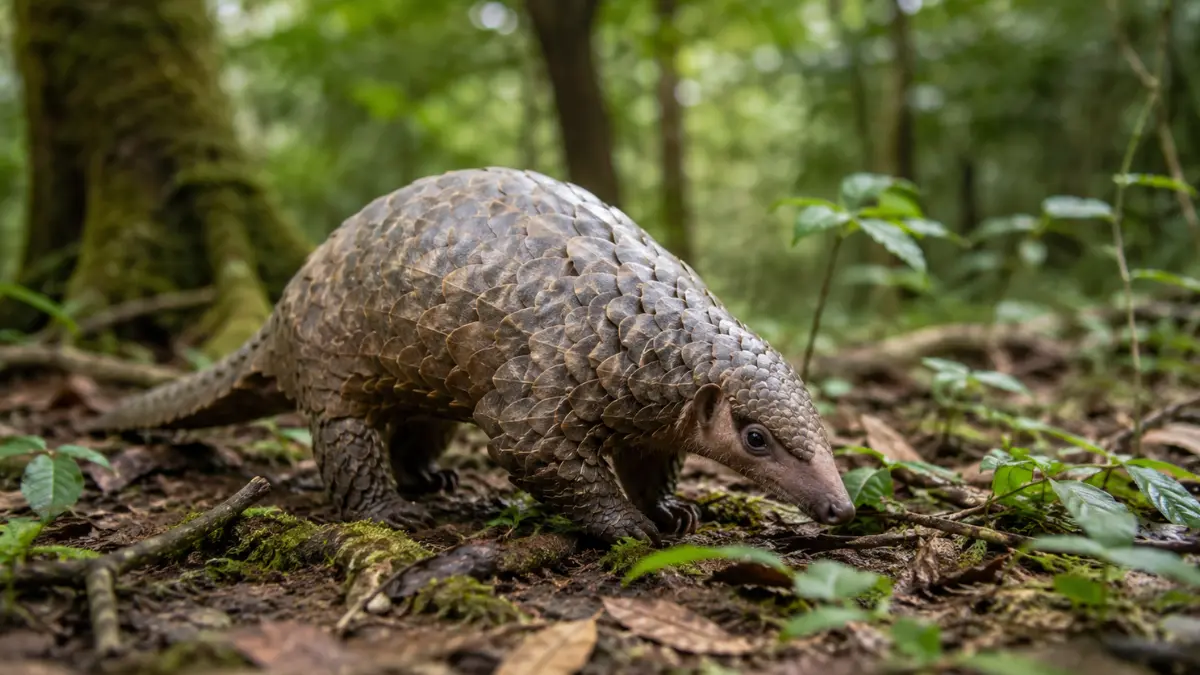

Scientists have confirmed that the Himalayan pangolin is a distinct species rather than a regional form of the Chinese pangolin.
The animal carries the scientific name Manis aurita, first introduced in 1836. Modern DNA analysis, museum specimens and detailed body measurements now show that Himalayan pangolins form their own evolutionary lineage.
The finding does not describe a newly discovered animal. It restores the scientific identity of a pangolin that researchers had grouped with the Chinese pangolin for generations.
What Scientists Confirmed About the Himalayan Pangolin
Researchers found clear genetic and physical differences between the Himalayan pangolin and the Chinese pangolin, Manis pentadactyla.
The Himalayan samples formed a separate genetic group across multiple analyses. Measurements of their skulls, bodies, tails, feet, snouts and ears supported the same conclusion.
Scientists estimated that the Himalayan and Chinese pangolin lineages separated about 1.8 million years ago. Since that division, they have followed largely independent evolutionary paths.
The available evidence connects the Himalayan species with Nepal, southern Tibet and Assam. Researchers still need more field records before they can define its complete geographical range.
Why Scientists Confused It With the Chinese Pangolin
Naturalist Brian Houghton Hodgson described the Himalayan pangolin from Nepal in 1836 and named it Manis aurita.
Later taxonomists placed the animal under the Chinese pangolin because the two species share a similar appearance. Both have overlapping protective scales, long snouts, strong claws and tapered tails.
Researchers at the time also lacked genetic tools. They depended mainly on a limited number of skins, skulls and written descriptions.
As classifications changed, Manis aurita gradually lost recognition as a separate species. Scientists treated the name as a synonym or used it for a regional form of the Chinese pangolin.
Modern genomic evidence allowed researchers to revisit that decision with far more information.
How a Historical Museum Specimen Solved the Naming Question
A historical pangolin skin held by the Natural History Museum in London played a central role in restoring the species.
The specimen represents Hodgson’s original Manis aurita description. Scientists extracted genetic information from it and compared the results with modern pangolin DNA.
The museum specimen grouped with the Himalayan lineage rather than with the Chinese pangolin. This result connected the old scientific name directly with the distinct population identified through modern genetics.
Museum collections often preserve evidence that researchers could not fully analyse when collectors first obtained the specimens. Advances in DNA recovery now allow scientists to answer questions that remained unresolved for more than a century.
In this case, the preserved skin helped establish both the species’ identity and its correct name.
What the DNA Analysis Revealed
Researchers examined nuclear DNA and mitochondrial DNA from historical and modern pangolin samples.
Nuclear DNA contains genetic material inherited from both parents. Mitochondrial DNA usually follows the maternal line. When both types of DNA reveal the same separation, they provide stronger evidence for distinct evolutionary lineages.
The Himalayan samples repeatedly formed their own group. They did not fall within the main Chinese pangolin lineage.
The analysis also found little genetic mixing between the Himalayan and Chinese groups after their separation. This pattern indicates that they developed independently rather than remaining part of one continuously interbreeding population.
Scientists combined the genetic evidence with geographical and anatomical information before confirming the species.
How the Himalayan Pangolin Differs Physically
The Himalayan and Chinese pangolins can look very similar during a brief sighting. Their most useful differences appear through careful measurements rather than one obvious feature.
The Himalayan specimens generally had longer bodies and tails, larger hind feet, longer snouts and smaller ears than the Chinese pangolins included in the research.
Scientists also identified differences in several parts of the skull. These included variations in the snout, palate and lower cranial structure.
The researchers used linear measurements and three-dimensional skull landmarks to compare the specimens. Statistical analysis separated the two groups consistently.
These physical differences supported the DNA results and reduced the likelihood that the genetic separation represented only local variation within one species.
Can Scale Patterns Identify the Himalayan Pangolin?
Scale patterns alone may not provide a reliable identification.
Researchers did not find a clear difference in the number or arrangement of scale rows between the Himalayan and Chinese specimens. Both species can therefore appear almost identical from a distance.
This similarity helps explain why the classification remained uncertain for so long.
Field researchers may need detailed body measurements, skull evidence or genetic samples to confirm a Himalayan pangolin. Photographs can support identification, but they may not show enough detail in every case.
Scientists should therefore treat unverified historical records cautiously, especially when they come from areas where the ranges of related pangolin species may approach each other.
Why the Name Manis aurita Takes Priority
Scientific naming normally gives priority to the oldest valid name assigned to a species.
Hodgson introduced Manis aurita in 1836. Once researchers confirmed that the historical specimen belonged to the distinct Himalayan lineage, that name became the strongest candidate for restoration.
A newer name, Manis indoburmanica, had been proposed for genetically distinct pangolins from the Himalayan region. The later research showed that those animals belonged to the same lineage as Manis aurita.
Because the 1836 name came first, Manis aurita takes priority. The newer name becomes a later synonym rather than a separate species name.
This correction prevents two scientific names from continuing to describe the same animal.
Is the Himalayan Pangolin a Newly Discovered Species?
The Himalayan pangolin is not a newly discovered animal.
People living in the region already knew the animal, and Hodgson formally described it nearly 190 years ago. The species later lost recognition when researchers placed it under the Chinese pangolin.
The 2026 research revalidated its separate status with stronger evidence.
A revalidated species differs from a newly discovered species. A new discovery describes an animal that science had not formally recognised before. Revalidation restores an older classification after new research confirms that it represents a genuine species.
The important development involves the animal’s scientific identity, not its first appearance in human knowledge.
Where the Himalayan Pangolin Lives
Confirmed evidence places the Himalayan pangolin in Nepal, southern Tibet and Assam.
The known records suggest that it occupies part of the southern Himalayan region and nearby Northeast Indian landscapes. However, scientists have not yet mapped its full distribution.
Pangolins remain difficult to study because they usually move at night, avoid open areas and spend significant time inside burrows or dense vegetation.
Researchers may also have misidentified some older Himalayan records as Chinese pangolins. Scientists will need to examine museum specimens, photographs and biological samples again where suitable evidence survives.
Future surveys may establish whether the species also occurs in additional parts of Northeast India, Bhutan, Myanmar or adjoining regions.
Why the Assam Records Matter
Assam represents one of the confirmed areas connected with the Himalayan pangolin lineage.
The state lies between the Himalayan foothills, the Brahmaputra Valley and forest systems extending toward Southeast Asia. This geographical position allows wildlife from several biological regions to occur within a relatively limited area.
The finding means researchers may need to reassess older pangolin records from Assam. Some animals previously labelled as Chinese pangolins may belong to Manis aurita, although scientists cannot change those records without supporting evidence.
The confirmation also shows why Northeast India requires continued wildlife research. The region contains species and biological patterns that remain poorly documented despite generations of local knowledge.
India’s World Cup cicada and its unusual four-year life cycle provides another example of a Northeast species whose scientific documentation remains incomplete. The cicada and pangolin are unrelated, but both show how much regional biodiversity still requires focused study.
How It Differs From the Indian Pangolin
The Himalayan pangolin is not the same species as the Indian pangolin.
The Himalayan pangolin carries the scientific name Manis aurita. The Indian pangolin carries the name Manis crassicaudata.
The study primarily distinguished the Himalayan species from the Chinese pangolin, Manis pentadactyla. It did not replace or rename the Indian pangolin.
Using “Indian pangolin” for every pangolin found inside India can create confusion. National borders do not always match wildlife distributions, especially in Northeast India, where several ecological regions meet.
Accurate identification requires the species’ physical, genetic and geographical evidence rather than its country of occurrence alone.
Why Separate Species Recognition Matters
Conservation planning depends on knowing which species lives in a particular area.
When scientists group two distinct animals under one name, the combined species may appear more widespread or abundant than either lineage actually is.
Separating them can reveal that each species occupies a smaller range, contains fewer individuals or faces different local threats.
The Himalayan pangolin now requires its own population surveys and habitat assessments. Researchers need to determine where its strongest populations survive and whether forests still connect them.
Different wildlife species also require different conservation approaches. Human-elephant conflict in Assam often involves disrupted movement corridors, farms and settlements. Pangolin protection also depends on healthy habitats, but secretive behaviour and identification difficulties make specialised surveys especially important.
How the Finding Could Help Wildlife Forensics
The genetic differences identified in the study could improve wildlife-forensic investigations.
Authorities sometimes recover pangolin biological material without enough visible features to identify the species. DNA testing can provide a clearer answer when laboratories have reliable reference samples.
Recognising the Himalayan pangolin gives investigators a more accurate genetic category. Material once labelled broadly as Chinese pangolin may require reassessment when it matches the Himalayan lineage.
Correct identification can help researchers understand which populations face pressure and which geographical regions require stronger protection.
Taxonomic research cannot stop illegal wildlife trade on its own. It can, however, strengthen evidence, improve population monitoring and prevent records from several species being combined incorrectly.
Does It Already Have a Separate Conservation Status?
The scientific confirmation does not automatically create an immediate separate conservation assessment.
Wildlife databases, government agencies and international conservation organisations follow their own review procedures. They must examine the new evidence, update scientific names and evaluate the species independently.
Researchers currently understand the Himalayan pangolin’s identity better than its population status.
They have confirmed that it forms a separate species, but they do not yet know its total population, complete range or rate of decline.
A reliable assessment will require verified field records, habitat information, population trends and evidence about threats across the region.
Until scientists gather that information, precise claims about how many Himalayan pangolins remain would be unsupported.
What Scientists Still Need to Discover
The complete range of Manis aurita remains uncertain.
Researchers need verified records from more parts of Assam, Northeast India and the wider Himalayan region. They must also identify any areas where Himalayan and Chinese pangolin populations come close to each other.
Future studies could examine the species’ preferred habitats, elevation range, movements, breeding patterns and use of burrows.
Genetic surveys may reveal isolated populations that require separate conservation attention. Museum specimens may also help correct older distribution records.
Scientists should not assume that every behaviour documented in the Chinese or Indian pangolin applies equally to the Himalayan species. Separate recognition creates the need for separate ecological research.
What the Confirmation Changes
The Himalayan pangolin is no longer best understood as a regional population of the Chinese pangolin.
DNA from modern animals and a historical museum specimen placed it within a separate evolutionary lineage. Skull and body measurements supported the same conclusion, while the original 1836 description established the correct name.
The evidence gives Assam and the wider southern Himalayan region a distinct pangolin species whose population and complete distribution remain poorly known.
Scientists have now clarified the animal’s identity. The next challenge involves finding where it survives, understanding its ecological needs and protecting its remaining populations with species-specific evidence.

1 thought on “How Museum DNA Identified the Himalayan Pangolin”